...where distraction is the main attraction.

Wednesday, April 6, 2022

Sirius 31 year old 1988 blended malt, North Star Spirits

North Star Spirits Week continues. The 11 year old Caol Ila was terrific, while the 20 year old Clynelish was hard to get a handle on, just beyond reach, slipping beyond my grasp. And so on.

Today it's a 31 year old blended malt, distilled in 1988. I'm unsure of its ingredients, but with its large outturn and 43.1%abv cask strength, Sirius likely included a number of casks that had dropped below the legal strength. That's not a problem as long as the whisky tastes good and the price is under €200. The latter was true. Time to check out the former.

This is Sirius.
Company: North Star
Range: Cask Series 009
Type: Blended (or Vatted) Malt
Distilleries: in Scotland
Age: 31 years (1988-2019)
Maturation: first fill bourbon barrels
Outturn: 3,582 700mL bottles
Alcohol by Volume: 43.1%
Chillfiltered? No
Color added? No
(from a bottle split)

NOTES

Immediately, the nose brings to mind milk chocolate bubbling in a double boiler. Then cassis and Good 'n Plenty candies. Hay and charred corn drift through the background. It gets fruiter with time, gaining nectarines, honeydew, creamsicles and roses. Something slightly meaty too.

The palate first registers medicinal with toasted oak spices around the sides. But then it goes to dessert. Vanilla ice cream, peaches, plums and yuzu candy. Very gentle, though, so I won't add water.

It finishes with lots of honey, peaches and bitter lemon soda.

WORDS WORDS WORDS

Sirius would be a great casual sipper, and I do mean casual. That's no sin, but if its ABV went any lower the palate and finish would vaporize. Frankly, it's more like ...... Canis Minor.  *wink*

When I tasted this whisky, I thought it was a blend of refill sherry casks, specifically due to the nose notes but, alas, first fill American oak barrels were its homes for more than three decades. In any case, I really like the style. Sadly we can't expect a matching sequel batch at a higher strength, but perhaps another North Star blended malt...

Availability - It might still exist in Europe, or the night sky
Pricing - less than €200
Rating - 87

Tuesday, April 5, 2022

Caol Ila 11 year old 2009 North Star Spirits

The original plan was to review four North Star Spirits malts this week, but the Clynelish didn't quite follow the script. So now I'm down to three: one youngin' and two oldies. It has also been brought to my attention (by me) that I haven't written about a Caol Ila in nearly 16 months. So here we go, one single sherry cask of Caol Ila!


Distillery: Caol Ila
Region: Islay
Owner: Diageo
Independent Bottler: North Star Spirits
Range: Cask Series 011
Age: 11 years (Sept 2009 - Oct 2020)
Maturation: first fill sherry butt
Outturn: 410 (possibly part of a bottle split?)
Alcohol by Volume: 58.2%
Chillfiltered? No
Caramel Colorant? No
(from a bottle split)

NEAT

Ocean, bacon and band-aids (Spring Break, bruh, amirite?) on the nose. Peaches and almond butter fill in the midground, hints of iron and lemon in the background. The zippy, zesty palate is almost effervescent, glowing with sooty peat, herbal peat, citrus peels and salt. Lemons and soot take over the finish, with chiles and salt around the edges.

I'm not going to water this one down too much.

DILUTED TO ~50%abv, or 1 tsp of water per 30mL whisky

More of the ocean, mixed with wet peat, leads the nose now. Soil, mint leaves and newspaper print appear after some time. The palate loses none of its power. More chiles and more earth up front. Salt and lemons highlight the rest. The finish might be a little shorter, and slightly heavier on the chiles, but it matches the neat finish otherwise.

WORDS WORDS WORDS

There aren't many better contemporary whiskies than proper Caol Ila sherry casks. This one sticks the landing, then shouts about it. Angus calls it, "Kind of like a bar brawl captured in a tasting glass," and I think I can allow that poetry today. Really, this is an excellent enormous whisky that would thump any of CI's Islay cousins' special releases.

Availability - Gone :(
Pricing - was under €80 two years ago (yeah, we missed it)
Rating - 90

Monday, April 4, 2022

A short story about a 20 year old Clynelish

 I'm doing a tasting of this sample of 20 year old Clynelish, er, Lynch Isle:

Distilled in 2000 and bottled by North Star Spirits in 2020, the whisky spent its life in a sherry butt, then a Portuguese brandy butt. Seems like a whole lotta effort to murder a Clynelish, but I'll keep an open mind, especially since I know squat about Portuguese brandy. That's Randy's realm.

It does have a nice medium gold color to it, once it fills the bottom half of the Glencairn bowl.

Lots of cocoa, raw walnuts, raw Brazil nuts and very dry sherry on the nose. Some hot driveway gravel, a bit of brine, some white flour--

Fuck.

I just.

I just knocked the glass off the table, spilling all the whisky onto the floor.

20 year old Clynelish. At least the living room will smell nice for a while.

I mean, I'm not the kind of person who'd get on his hands and knees to suck it out of the carpet.

Friday, April 1, 2022

Killing Whisky History, Episode 40: Johnnie Walker Red Label, bottled 1968-1976

It's time to bring Diageo Month to a close by opening up a dusty Johnnie Walker Red Label. There's even a sparring partner from the 1980s! *SPOILER ALERT* They don't taste like the current version of Johnnie Red.


Monday, March 28, 2022

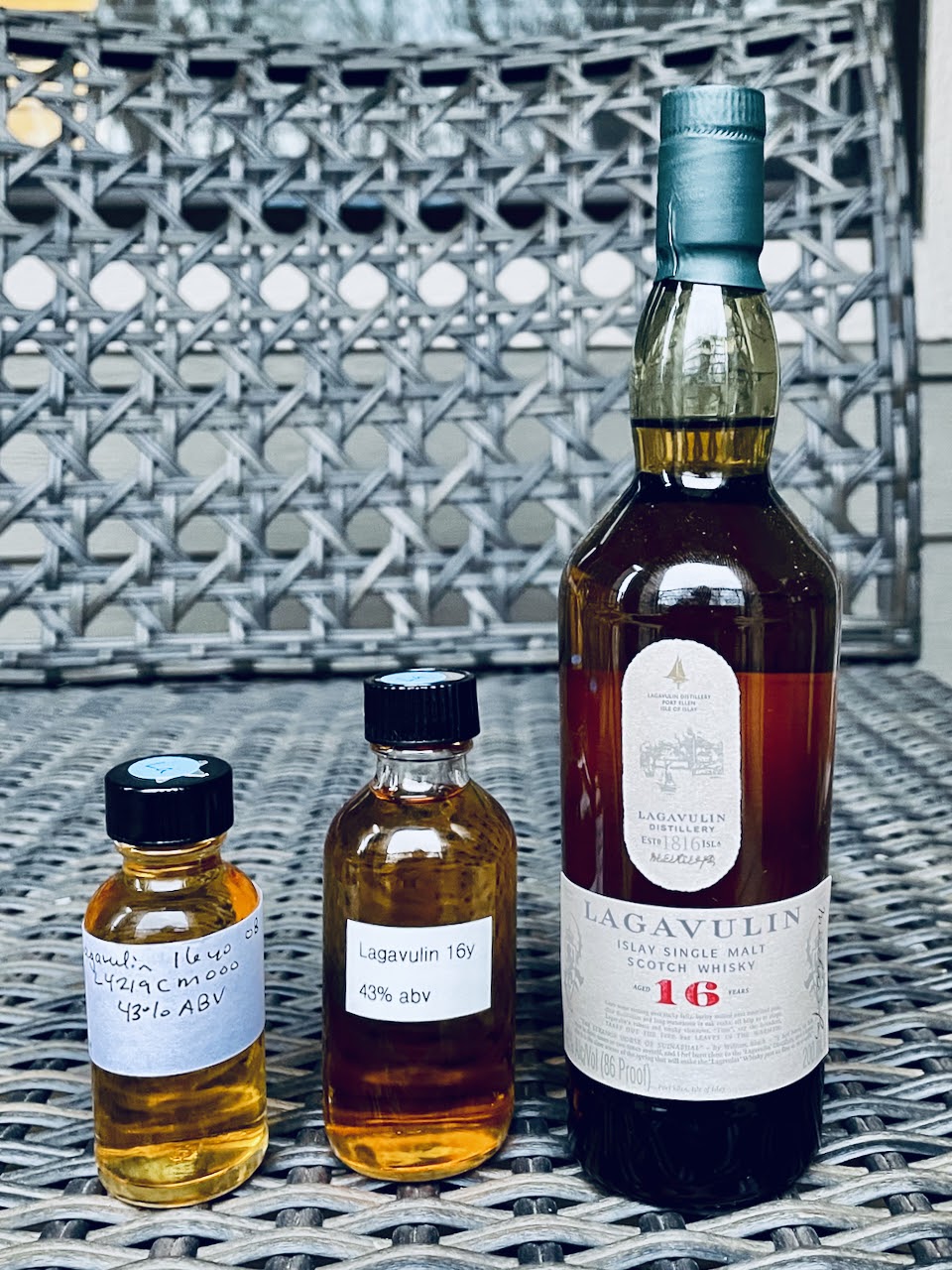
Three different batches of Lagavulin 16 year old

As much as major producers, like The Edrington Group, Pernod Ricard and Diageo, strive to keep batch variation to a minimum for their most popular whiskies, fluctuation is inevitable. Casks and demands vary, resulting in changes, sometimes subtle, occasionally sizable. Springbank prizes these shifts, Macallan probably doesn't.

Lagavulin 16 year old's production process has remained reliable through the years, but it too varies. And I'm not just talking about the White Horse Distillers era compared to 21st century bottlings. Differences can be spotted from batch to batch across the past decade.

Though my original intent was to compare a 1991 batch with a 2021 batch, owners of the earlier bottles have become unwilling to part with their whisky for anything less than a mint, so this tasting became more micro.

I will be comparing samples from a 2014 750mL bottling (my bottle), 2017 750mL bottling (sourced sample), and a 200mL bottling from 2018 that I just opened.

Lagavulins Sixteen:

L4219CM000
bottled 2014 - 43%abv
L7060OM000
bottled 2017 - 43%abv
L8213IU002
bottled 2018 - 43%abv
The nose starts off mossy, metallic and tangy with touches of balsamic vinegar and molasses in the background. With time, it picks up notes of cannabis ash, honey and mango.It noses of peated dark chocolate, mud, rotting fish, iron and burnt newspaper. The whisky gains more classic smoky notes with time without losing its Croftengea-esque style.Toasty peat, lemons, oats and molasses make up most of the nose. Ocean and seaweed arrive next, with a subtle manure note appearing at the 60-minute mark.
A good mix of sweet, salt and kiln in the early palate. Some tart oranges and limes in the background. Later sips gain herbal bitterness, menthol and ginger beer. The kiln note never subsides.Almonds, good bitterness and heavy smoke start off the palate, followed by fig, cannabis and extra tart grapefruit. Slightly tarry in the background.The sweetest of the three, and the least smoky. The palate has the herbal bitterness, some lemons, and a hint of cannabis. The peat reads like cold kiln.
The citrus strengthens in the finish, meeting well with sturdy leafy smoke, and hints of charred beef in the far back.It finishes sweeter than the palate, while keeping the big dark smoke. Tiny bits of bitter citrus peel linger in the background.It finishes leafy and tangy, with a mix of secondary lime, moss and dried sage notes.

WORDS WORDS WORDS

These were three different whiskies. The 2014 had the most complex nose and finish, as well as the most balanced palate, proving to be the most (positively) stereotypical Lagavulin 16. I would not have guessed the 2017 was Lagavulin had I tried it blindly. Its quirky nose could startle some Lagavulin purists, though the palate falls more in line. The finish was shorter than the 2014's and quite sugary. Gripes about the 2018 are probably minor, it's the simplest of the trio but right on-target throughout.

The 2014 possesses more heft and charm than than the other two. Some weird casks slipped into the 2017, which could have made it the best of the three at a higher ABV. Meanwhile, a narrowness has crept into the 2018 preventing it from truly soaring. It's a lighter whisky than the other two, almost like a 40%abv bottling.

Despite these differences, not one of these three Lagavulins was bad. Each was a coastal heavily peated malt, each would warm a winter belly well. But they're not the same, nor similar, really. Their few common notes could be found in other heavily peated malts. It's just something to keep in mind. But I do hope the 2018's limitations aren't the start of a trend. I'll keep a sample so I can compare it with a later bottling some years down the line.

RATINGS:
L4219CM000, bottled 2014 -- 89
L7060OM000, bottled 2017 -- 85
L8213IU002, bottled 2018 -- 87

Friday, March 25, 2022

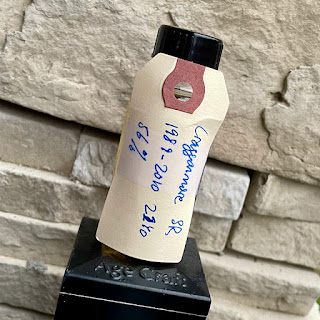
Cragganmore 27 year old 1989 Archives, cask 1465

Monday's Cragganmore was not good. Wednesday's Cragganmore was a drinker. How will today's Cragganmore fare? It's from the 1989 vintage just like Wednesday's official bottling, though this one is older and from a sherry hogshead. Its hue is very dark, so one can anticipate the whisky will taste different than this week's other two Craggs.

Distillery: Cragganmore
Owner: Diageo
Region: Speyside (Moray)
Bottler: Archives
Age: 27 years (May 1989 - November 2016)
Maturation: sherry hogshead
Outturn: 70 bottles (a split cask?)
Alcohol by Volume: 48.7%
Chillfiltered? No
e150a? No
(from a bottle split)

NOTES

The layered nose shows toffee chips, baked apple and marzipan on top of soil and stones. Smaller notes of mango and golden raisins settle in the background. Diluting it to 43%abv cranks up the sherry cask. Cherry syrup, golden raisins and beef up front, with stones and toffee in the middle. Baked apple and florals in the back.

This one has more of an industrial note than the other Craggs' palates, though it also offers Manuka honey, guava and a little bit of orange. But with time it turns into sugary oak reduction, much like an old bourbon. The tannins remain at 43%abv, but the sweetness gets gentler, lychee and grapefruit show up, as does a spicy zing. So the palate does the reverse of the nose.

It finishes like a 15+ year old bourbon. Mouth drying, lots of old wood. Some ash and a hint of orange. Once the whisky is reduced to 43%abv, the finish nearly matches the palate, with a little more fruit.

WORDS WORDS WORDS

It's a bourbon drinker's scotch. That's what my brain kept saying as I sipped this neatly. As with the official '89, dilution mellows the palate's oak and adds fruit, both plusses in my book. In fact, there's a 6 to 8 point swing once water is added because I really couldn't get into its Orphan-Barrel-meets-pseudo-Stagg style. Like long-aged bourbons, this Cragganmore's nose was very nice at all strengths but, again, whisk(e)y is for drinking.

Availability - Long gone
Pricing - around €200 five years ago
Rating - 85 (with water only, high 70s when neat)

Wednesday, March 23, 2022

Cragganmore 21 year old 1989, Special Release 2010

Wow, Cragganmore 12 was disappointing. I hope I can reuse the bottle or something. Anyhoo, this blog needs more reviews of older Cragganmore, so I will be reviewing one 1989 today, and another 1989 on Friday. Today's '89 was from Diageo's 2010 Special Releases, a set that included my favorite Glen Spey and a very good Auchroisk. I hope the Cragg's quality can match theirs!

Distillery: Cragganmore
Region: Speyside (Moray)
Owner: Diageo
Range: Special Releases
Age: 21 years (1989-2010)
Maturation: Refill American Oak!!!
Outturn: 5856 bottles (identical to that of the Auchroisk)
Alcohol by Volume: 56.0%
Chillfiltered? No
e150a? Possibly not
(from a bottle split)

NOTES

The nose offers a mix of spirit and cask. Hay, ocean water and old bowling shoes. Vanilla pods, caramel chews and toasted coconut-coated marshmallows. It shifts significantly once the whisky gets reduced to 43%abv, turning into lemon bars (but with yuzu), pound cake, blueberry jam and a subtle grassiness.

The palate leads with tart oranges, coal smoke, malt and a hint of soil. It takes on more tannins with time. The oak hushes up once the whisky is dropped to 43%abv. It's super tart, lots of limes, lemons and blackberries, with hints of florals and bitterness in the background.

The citrus turns sweeter in the finish, with bits of earth and tannin throughout. At 43%abv, the citrus becomes more complex, balancing sweet, tart and bitter.

WORDS WORDS WORDS

Hear ye, hear ye, I like this better with water! It's a bit woody when neat, reading more like first-fill than refill casks. The nose transforms at 43%abv, and the palate's citrus improves. It ain't dreamy, mostly a casual drinker, yet such an improvement over the standard 12 year old. A standard 18yo or 21yo Cragganmore at 43%/46% would be very interesting were it offered at the right price. 

Availability - May still be available after all this time
Pricing - anywhere from $200 to $350
Rating - 86 (hydrate it!)