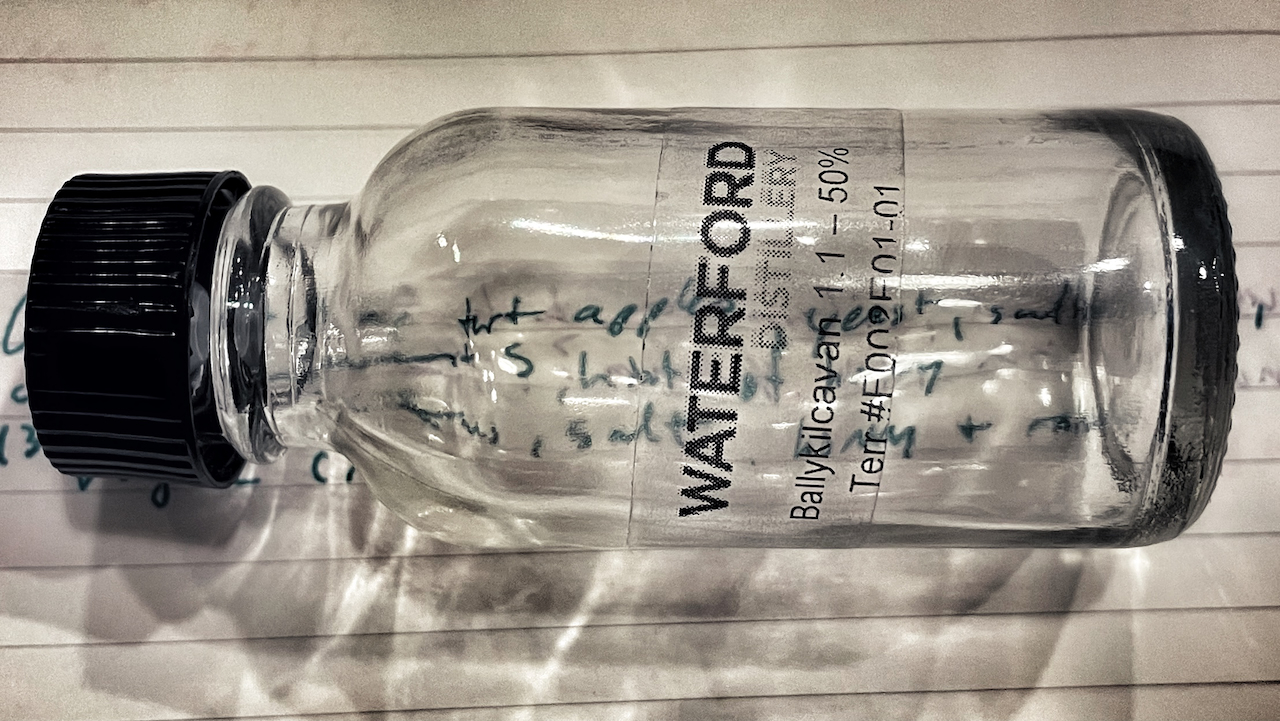
Region: Waterford, Ireland
Outturn: 9000 bottles
Alcohol by Volume: 50%
Chillfiltered? No
e150a? No
(from a bottle split)
In yesterday's Waterford intro, I left out one fun fact about all five of this week's single malts: each uses a single farm's barley. No matter what my feelings are about the final products' immaturity and cask choices, I do adore the single farm idea. The Ballykilcavan barley (Taberna strain) comes from David Walsh-Kemmis's farm in County Laois, a ways west down M7 from Dublin.
Ballykilcavan 1.2 is about 3 months older than the 1.1, taking it into the 4 year old realm except for the fact that the distiller mixed some 1.1 into the 1.2, so it technically has the same age statement.
Waterford Ballykilcavan 1.2
NEAT
At first sniff, the nose is perkier than that of the 1.1 with less sulfur and more French sauvignon. Then come the flowers, raspberry jam and grape candy. While a yeast note remains, this reads more like newmake than wort. The palate comes off hotter than the 1.1's. It's full of sweet grapes, tart apples, and sharp peppercorns. There's some savory earthy sulfur, but not much. It gets sweeter with time. Honey, sultanas and tart apples mix with dry Oloroso in the finish.
I love Ireland and I love Irish whiskey, so I'm rooting for one of the scores of new Irish distilleries to legitimately challenge the old guard. Waterford Distillery seemed like it was best dressed for success. Mark Reynier had a dozen years of experience resurrecting Bruichladdich Distillery on Islay. With Waterford his team has put a lot of emphasis on Ireland's terroir (or tēireoir per the website), and the official site is loaded with geeky details about every bottled batch. So I decided to start sourcing Waterford samples.
Then I attended a tasting of six Waterford whiskies. And I enjoyed approximately 0 of them.
Two elements troubled the whiskies. Firstly, they're three-year-old whiskies that tasted like three-year-old whiskies, hot, yeasty, and too unformed to get a sense of the barley. Secondly, not only can Reynier not quit his love of wine + whisk(e)y, but (per his interviews) he's committing to it 100%. I have a difficult time discerning how French wine casks promote Irish terroir, both in theory and the reality of the liquid.
So I stopped amassing Waterford samples with those I'd obtained via bottle splits before that tasting. I'm going to try each of the five this week.
First up:
Waterford Ballykilcavan 1.1
Lefty Gomez, the always quotable ace of the Yankees pitching staff across the late Babe Ruth era, Lou Gehrig era and early Joe DiMaggio era, passed away on February 17, 1989.
A week later, my family bought our first pet, the most adorable of domesticated rodents, a hamster. I named him Lefty. I don't know if he was really a southpaw (zing!), but I was a baseball history geek who'd just turned 10½, so it didn't matter. Lefty was fuzzy and fast, didn't mind being held, and had a great time making nests in his wood shavings. He also had virulent case of wet tail, and had to take medicine every day.
Seven months later I found my hamster on top of his bedding, expired from dehydration, having shit himself to death. It was summer, we wrapped him in a sock and buried him in the backyard. My mom and I cried.
This is a bottle of whisky someone abandoned at a Columbus Scotch Night event this year:
(Loch Lomond cluster homepage)
I'm wrapping up this cluster a few days late due to some rare travel last week, thus this conclusion awkwardly drops on a Monday.
Speaking of awkward, I used to think Loch Lomond Distillery produced the most awkward whisky in Scotland. (Seamless transition!) Something changed abruptly once Exponent bought Loch Lomond Distillers. That "Something" was the magical disappearance of the rancid Taco-Bell-garbage-dumpster note I used to identify as Distillery Character. That "Something" was also the distillery's sudden focus on single malt promotion. That "Something" was also the constant rebooting of package design.
The last two somethings are corporate decisions, but the first is more mysterious. Was former owner, Glen Catrine, that bad at selecting casks for official bottlings? And very consistently so? That doesn't explain where that unsettling garbage note went. I found it a grand total of 0 times during this cluster, with the '90s bottling of Inchmurrin 10yo coming the closest to that style of murky fluid. You will rarely rarely rarely hear me speak well of investment groups and VCs, but Exponent built something new upon takeover, something that works. And maybe fished the dead rats out of the stills.
All four of Loch Lomond's single malt styles shown brightly during this cluster:
Inchmoan was the biggest surprise, since I didn't even enjoy that malt after the takeover. But here it averaged the best scores of the four types (tied, actually). Each of the four Inchmoans read differently, so the only constant was quality. But what quality!
Inchmurrin was probably the weakest of the four styles, possibly because it didn't have peat to hide behind, but at least the aforementioned '90s Inchmurrin highlighted how much has changed for the better.
Croftengea, a remedy for those of us tired of the same-old-same-old peated stuff, remains my favorite non-Islay peated whisky. And I wonder if we've even seen the best of it.
Like Inchmurrin, the Loch Lomond type doesn't have the luxury of peat to cover up spirit flaws but, aside from the 18yo, it can be a solid, fruity whisky. The older stuff improved with water, and the 12yo was the closest thing I've had to a "daily drinker" for years.
The cluster's 14 modern Loch Lomond malts averaged 86 points! A decade ago a Loch Lomond cluster would have peaked at 68 points and I would have quit whisky blogging. (Don't everybody sigh at once.) 88- to 90-point scores made up 40% of the reviews in this cluster, which I admit sounds like some dreamy, Whisky Advocate stuff. But it's real. Loch Lomond makes good whisky.