...where distraction is the main attraction.
Showing posts with label Compass Box. Show all posts

Wednesday, July 30, 2025

Things I Really Drink: Compass Box Artist Blend Single Marrying Cask, cask 4 for Binny's (with guest review!)

Generations (11 years?) ago, when Compass Box first released their Great King Street Artist's Blend, it received raves aplenty. But not from me. I thought it was unremarkable, though very drinkable. The 43%abv hurt it, as did the grain component.

Years later, Compass Box started offering exclusive retailer single casks of the blend at 49%abv. (Due to some sort of rebranding the Great King Street and 's were removed, making it "Artist Blend".) The prices tended to be pretty reasonable at $50-$60, so I picked up a bottle from Binny's last year.

This particular cask was an ex-Palo Cortado butt that had previously held Linkwood's single malt:


Though that cask sounds sort of random, there's actual method to it. One of the Doctors Springbank did some digging around, finding out that Linkwood Palo casks were part of Compass Box's Nectarosity blend. It had been a first-fill for Nectarosity, so CB found additional uses for it.

Linkwood is good stuff, and I do like me some Palo Cortado matured whisky, so the $50 sale price made it a given for me.

Unfortunately, I never really "got" the whisky. By the bottle's midpoint, I realized I appreciated it but didn't actually like it. With the looming possibility that I was missing something, I retained the services of both Doctors Springbank, requesting their tasting notes for this bottle. So first, I present ye with their review.

From the Doctors Springbank

Nose: Waxy, overnight oats with honey and orange marmalade. Pear and ginger. Pineapple upside down cake with orange zest 

Palate: Fresh milled barley, hay, walnuts, orange peel, Honey, apricot, white pepper.

Finish: Long lingering dry wood tannins

After sitting in the glass for 40 minutes

Nose: Vanilla tootsie roll, lemon poppyseed pancakes, hay

Palate: Muscovado sugar, poached pear, unripe banana, lemon zest, white pepper, 

Finish: Long dry bittersweet chocolate, walnuts.

Notes: Overall decent dram. It had overwhelmingly bourbon barrel characteristics. We had trouble finding the palo cortado influence.

Thank you both for your notes!


I did two separate tasting sessions. First, I compared it's highball side-by-side with that of Johnnie Walker Double Black and Hibiki Japanese Harmony. TIRDs aplenty! Then, on a different night, I consumed plenty of Artist Blend neatly. Here's what I found:

HIGHBALL

Lots of baking spice and caramel right up front. Butterscotch appears in later sips. Mostly vanilla at the bottom of the glass.

This follows the bourbon barrel reference from the Doctors. For what it's worth, I like this highball the least of the three.

NEAT

The nose starts with a curious mix of oranges, nectarines, steel wool, and almond extract. Some cherry bubblegum appears around the edges, with vanilla bean in the background. It gets more floral with time, picking up lemon cake notes. More oranges in the palate, now joined by Granny Smith apples and whole wheat bread. It's tart and acidic at first, then gets much sweeter with time, gaining ginger beer and rose notes. Its decent-length finish offers mostly tart and tangy citrus, dusty spices, vanilla, and ginger candy, also growing sweeter with time.

WORDS WORDS WORDS

I'm relieved to see we found similar notes, like oranges and lemon (pan)cakes on the nose; oranges, grain, and sugar in the palate; and woody stuff in the finish. I also can't find the Palo Cortado cask in this, just lots of bourbon barrel action and sweet grain whisky. Could this have been a third-fill, with Nectarosity being #1, the Linkwood Artist Blend element as #2, and the marrying cask as #3? Or did that first blend soak up all the good stuff?

The now-archived Artist Blend was only 45% 11yo first-fill bourbon barrel Cameronbridge grain whisky, yet that ingredient shouts the loudest, with young Linkwood and young Balmenach offering secondary notes.

Having now focused on the whisky in a tasting, I do like it more that I had before. Still, I'm in no hurry to pour another glass of this. When I do, it'll be served neat or with a few drops of water.

Availability - Binny's Beverage Depot
Pricing - $60, or $50 on sale
Rating - 80 (neat only)

Friday, March 18, 2022

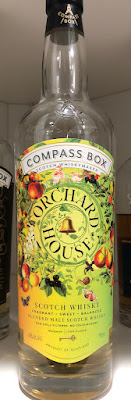
Things I Really Drink: Compass Box Orchard House blended malt

Time for the monthly TIRD! The first two TIRDs were of the blended whisky sort, while this one is a blended malt produced by a brand I used to hold in high regard.

If you ever get a chance to meet or watch John Glaser you'll immediately notice the man's patrician style. At first his elegance shone through in his brand's crisp, clean graphic design, and high quality whiskies in the $40-$60 range. But, Compass Box was never going to stop there. Familiarity was a starting point. Luxury malt was the destination.

This sort of observation has been aired previously by Bozzy and Whisky Monster, so I'm not breaking any new ground here. 2017's Three Year Old Deluxe and This is Not a Luxury Whisky names were a good chuckle, but their price tags were much higher than previous limited editions, and they began to make Glaser's quarrel with the SWA start to feel like a marketing scheme. Then, around 2019-2020, CB's limited releases came flying out at an almost monthly rate, which finally caused the bespoke hand-carved Compass Box sign to fall off its gently rusted hook inside my whisky brain. Did you follow that metaphor? I didn't.

It took last year's arrival of Orchard House, the standard range's newest member, for my interest to reawaken. Orchard House's marketing materials describe it as a "Fruit-Forward & Spirit-Driven" whisky. Its ingredients are approximately:

39% ~8 year old Linkwood from first-fill bourbon barrels
29% ~8 year old Clynelish from first-fill bourbon barrels
20% ~8 year old Benrinnes from first-fill bourbon barrels
8% ~6 year old Aberlour from "Revatted Oloroso Sherry-Seasoned Butt"
2% ~8 year old Caol Ila from first-fill bourbon barrels
2% ~10 year old blend of Glen Moray, Balmenach and Tomatin aged in heavily charred French Oak

I like Fruit-Forward & Spirit-Driven whiskies, and this mix sounded nice, so I split a bottle of Orchard House with my buddy, Dr. Springbank.

Brand: Compass Box
Type: Blended Malt
Age: see above
Maturation: see above
Alcohol by Volume: 46%
Chill-filtered? No
Added colorant? No
(from a 50/50 bottle split)

NOTES

The nose begins with unripened stone fruits, saline, cardamom and vanilla. Barley and candle wax fill the middle. Hints of band-aids, pickle brine and circus peanut candy keep the background lively.

A surprising raw heat roars loudest in the early palate. Once that peels away, the whisky turns floral and sweet. Some malt and tart limes appear occasionally. A woody bitterness appears later, alongside brown butter and salt.

It finishes very tangy and floral, with hints of cayenne pepper and salt around the edges.

WORDS WORDS WORDS

This is the first time I've been disappointed by a Compass Box blended malt. Yes, it was at times spirit-driven, but those first-fill casks still appear in awkward places. Unlike Spice Tree and Peat Monster, Orchard House doesn't feel like a complete piece. Even the company's blended whiskies, which fall far short of their malt cousins, arrive as a single unit on the palate. Thus, for the senses, Orchard House doesn't fit the Compass Box house style.

It's also not that fruity. Though I do list limes in the palate notes, I frequently find lime notes in young malts. What it's missing is the orchard. Where are the apples, pears, or ripe stone fruits?

I ended up drinking most of my half bottle on the rocks, which I've never done with a Compass Box blended malt. Not only will I not purchase a full bottle, I'm concerned about the current quality of the rest of their standard range.

Availability - Europe and the US
Pricing - $50-$60
Rating - 78

Wednesday, February 17, 2016

Compass Box Blended Malt Triple Taste Off: Oak Cross, Spice Tree, and Peat Monster

Finally, our third set of three CBs.  This time it's their three main regular range blended (or vatted) malts: Oak Cross, Spice Tree, and Peat Monster.  I've reviewed each of these before, but this time these samples were poured by me, rather than purchased from a retailer.  Plus these were all bottled in 2014.

COMPASS BOX OAK CROSS
Company: Compass Box
Type: Blended Malt
Distilleries: approximately 60% Clynelish, 20% Dailuane, and 20% Teaninch
Alcohol by Volume: 43%
Chillfiltered? No
Color added? No

COMPASS BOX SPICE TREE
Company: Compass Box
Type: Blended Malt
Distilleries: approximately 60% Clynelish, 20% Dailuane, and 20% Teaninch
Alcohol by Volume: 46%
Chillfiltered? No
Color added? No

COMPASS BOX PEAT MONSTER
Company: Compass Box
Type: Blended Malt
Distilleries: Ardmore, Laphroaig (current batch), Ledaig (current batch), Caol Ila (past batches)
Age: ???
Maturation: Fact sheet says just refill American oak, Tasting video says "30% first fill American oak, 70% refill American oak", so it might change from batch to batch
Alcohol by Volume: 46%
Chillfiltered? No
Color added? No

The Spice Tree sample came from my own bottle, gifted to me by my lovely wife.  The Oak Cross and Peat Monster samples were from two different OCSC events.  Because I know Spice Tree pretty well and Peat Monster is much different than the other two this Taste Off was not done blindly.


THE TASTE OFF!

OAK CROSS
Its color is a yellow amber.  The nose is big on flowers and fruit.  There's lemon, banana bread, peach schnapps, fresh apricots, orange marmalade, and floral teas.  There are also smaller notes of vanilla and pencil shavings.  When it comes to the palate, the bad news is that the mouthfeel is thin and there's little development.  Caramel and butter cookies balance with some bitter citrus and black pepper.  Vanilla, notebook paper, and a soft citric sweetness lingers in the background.  A little bit of spirity heat stays throughout.  The finish gets sweeter, focuses on vanilla and caramel.  Meanwhile some burnt oak and bitterness runs through the middle.

Comments: This one feels like it's lost something over the years.  It has a very good nose but a flat palate.  The finish does even less for me.  I wish some of the nose's fruits showed up on the palate and that the finish did something.  Maybe it needs the extra three points of ABV.  Maybe it needs more age.  Maybe it needs more Clynelish.  Not a bad whisky, but it no longer can keep up with...


SPICE TREE
This one has the darkest color, a medium gold.  LOTS of spice (obvs) in the nose, much of it is probably from the French oak, but it's sometimes reminiscent of American rye whiskey.  Other major notes: Spice cake, butterscotch candy, cocoa, fresh tobacco, and tapioca pudding.  With some breathing time, the whisky develops notes of salty beach air and lychee candy (Kasugai).  That spice cake shows up in the palate as well with notes of cloves, nutmeg, and (non-cassia) cinnamon.  There are limes and oranges, fruity shisha, dried apricots, toffee pudding, and a little bit of soil.  It finishes with rich vanilla ice cream topped with caramel sauce.  Oh, and butterscotch and toffee.  Cloves in the back along with a hint of cantaloupe.

Comments: I love this stuff.  My wife, who prefers American whiskey over Scotch, likes Spice Tree as well.  At times it seems to be the Scottish cousin of straight rye whiskey.  In any case, it's the one regular Compass Box whisky that consistently nails the nose, palate, and finish.  And man, does it stick the finish.

THE PEAT MONSTER
Very very pale in color, which is always appreciated here.  A surprising amount of oak spice on the nose in this one.  Perhaps there were some active US oak barrels in the mix?  The peat registers at a low rumble, kind of like a sugary Laphroaig.  There's some burnt beef and a hint of manure.  Caramel and whole wheat toast.  After 20ish minutes in the glass it finds a rotting beachside seaweed note and some dried herbs.  The palate is REALLY vegetal in its first few moments.  Then horseradish and cigarettes.  Cinnamon candy.  Somehow rooty, sweet, and tangy at the same time.  A peppery tingle throughout.  After those 20ish minutes in the glass, the whisky starts to get mossier and bitterer.  The decent length finish has a lot of salt and beach notes.  Some sage, moss, burnt bark, and black pepper.  It gets sweeter and sweeter with time.

Comments: Ye olde peat cow seems to get bolder every time I try it.  It's no longer as politely peaty as it use to be.  There's an edge to it now, something appreciated by some more than others.  Maybe there's more Ledaig in the mix.  Or maybe they're using younger whisky.  There's some young(?) sugariness to it that doesn't really dance so well with the other parts, keeping it from fully congealing.


FINAL THOUGHTS
These were all better than yesterday's blends, thank goodness, and at least two of them sorta earn their price.  I keep getting the feeling that the Oak Cross and Peat Monster (and Asyla) are using younger ingredients than they used to.  Perhaps that was inevitable, as Compass Box's popularity might eventually put a squeeze on their own stocks.  It doesn't hurt Peat Monster too much, but Oak Cross feels like it's fallen a step over the past couple of years.  It has gotten thin and plain, as if it has been filtered or bottled at 40% ABV.  Meanwhile, Spice Tree remains one of the best blended malts on the market, and it's a Scotch I feel confident in recommending to rye and high-rye-bourbon fans.  It has also held its price -- never moving more than $5 in its national average -- over the past five years, something I certainly treasure.

COMPASS BOX OAK CROSS
Availability - Most specialty liquor retailers
Pricing - $40 to $60
Rating - 82

COMPASS BOX SPICE TREE
Availability - Most specialty liquor retailers
Pricing - $55 to $75
Rating - 89

COMPASS BOX THE PEAT MONSTER
Availability - Most specialty liquor retailers
Pricing - $45 to $70
Rating - 85

Tuesday, February 16, 2016

Compass Box Blended Whisky Blind Triple Taste Off!

A lot of info to get through here, so I'll cut the usual schtick and get right to the candidates (all bottled in 2014):

COMPASS BOX ASYLA
Company: Compass Box
Type: Blended Whisky
Contents: 50% Malt Whisky (Teaninich and Glen Elgin) and 50% Grain Whisky (Cameron Bridge)
Age: ???
Maturation: first fill ex-bourbon casks
Alcohol by Volume: 40%
Chillfiltered? No
Color added? No
Official product fact sheet PDF

GREAT KING STREET ARTIST'S BLEND
Company: Compass Box
Type: Blended Whisky
Contents: 54% Malt Whisky (of which is 52% "Northern Highland (malty/fruity)", 31% "Northern Highland (grassy/perfumy), 17% "Speyside (meaty)") and 46% Grain Whisky ("Lowland")
Age: ???
Maturation: 66% first fill ex-bourbon casks, 26% New French oak "finish", 8% first fill ex-sherry butt
Alcohol by Volume: 43%
Chillfiltered? No
Color added? No
Official product fact sheet PDF

GREAT KING STREET GLASGOW BLEND
Company: Compass Box
Type: Blended Whisky
Contents: 67% Malt Whisky (numerous distilleries, amongst which Laphroaig, Clynelish, and maybe Dailuaine are included) and 33% Grain Whisky (Cameron Bridge)
Age: ???
Maturation: "A combination of first-fill Sherry casks, first-fill and refill ex-Bourbon barrels and a small portion of new French oak finishing."
Alcohol by Volume: 43%
Chillfiltered? No
Color added? No
Official product fact sheet PDF

All three samples were purchased at an OC Scotch Club event.

Awesome picture and great spelling, dude.
Thirty milliliters of each whisky poured its own Glencairn glass were arranged so that I did not know which was which.  So I numbered them 1 and 2 and 3.  First I tasted them neat, then added 1mL of water to each whisky at their halfway points.  Once the tasting was complete, I ranked each, graded them, and guessed which was which.  Two genuine surprises resulted......

THE TASTING

WHISKY 1
Neat:
The nose begins with Band-aids, lemon peel, and salty broth.  It's slightly herbal and has a bite of young rubbery peat.  Smaller notes of oats, sweat, and dog fur appear here and there.  The palate is very grassy with young herbally peat up front.  Ginger and dried oregano in the midground.  Bitter oak and pencil lead in the background.  It finishes mossy and gingery.  Mesquite smoke, vanilla, and an oaky bitterness develop after a few moments.

With water:
More rubbery peat in the nose now.  More vanilla too, followed by hints of dried cherries and dried apricots.  The palate gets mossier, though it loses the lead note.  A slight stone fruitiness mingles well with a good soft bitterness.  Large notes of vanilla and brown sugar.  The bitterness improves in the finish as well, meeting up with vanilla and extinguished cigarettes.

Comments:
By far the best nose of the three, whether neat or hydrated.  Though at the same time, it has the weakest roughest palate and a finish I didn't care for.  It shouts youth and maybe even some cask issues at times.  It fact it was comparable to the $20 Shieldaig Highland single malt I reviewed last year.  That doesn't bode well for a $40+ whisky.  The good nose can't totally save it.  GRADE: 79

WHISKY 2
Neat:
The nose is very mild, sometimes almost silent.  There are subtle notes of fresh peach, apricot, and cucumber.  Then there's toasted barley, vanilla, caramel, and American oak char.  It's really grassy.  The palate has the big grass note, though here it's dried clippings.  Vanilla, caramel, pepper, and mocha are in the midground.  A whiff of smoke meets a lot of fresh ginger.  It finishes simple and spirity.  Mostly pepper, salt, and ginger.  Maybe a little bit of caramel.

With water:
The nose is still super grassy, but now there are bigger fruit notes.  Bartlett pears and an orange creamsicle.  More grass in the palate.  Some dried herbs.  A hint of cardboard and some green woody bitterness.  The finish is mostly wood spice and bitterness, then grass and paper.

Comments:
This had the weakest nose of the three, though it did improve when the water was added.  Meanwhile the halfway decent palate totally collapsed when watered.  The finish was so-so, but again didn't react well to the water.  Overall it was the most disappointing of the three.  I can see how it makes for an okay unchallenging neat sipper, but with it falling apart when hydrated I wouldn't have much confidence when it's hit with ice or club soda.  GRADE: 77

WHISKY 3
Neat:
The nose has some sharp mineral notes which for some reason remind me of young Clynelish.  Small pine needle and bubblegum notes meet larger notes of roses, orange, and pear.  After 15-20 minutes in the glass, it fades into caramel and toasted almonds.  The fizzy palate is loaded with toffee.  There's some vanilla, whipped cream, and definitely some malt.  A hint of cardboard.  This has the best mouthfeel of the three whiskies.  It finishes fizzy like a ginger beer.  Then wood spice and vanilla.

With water:
The caramel and toasted almonds remain in the nose.  It's more sugary now and picks up some cardamom.  The palate simplifies into vanilla, sugar, caramel candy, and ginger powder.  Rock candy, vanilla, and black pepper in the finish.

Comments:
The nose ultimately ranked between the other two, but I probably would have it in first had it not nearly vanished after airing out.  This had the best palate, and really the great mouthfeel alone put it ahead of the others.  But then the finish was just so-so, again.  Water narrows it down rather than opening it up.  GRADE: 81

RANKS AND GUESSES:
NOSE (best to worst) - 1, 3, 2
PALATE - 3, 2, 1
FINISH - 2, 3, 1 (but I didn't really like any of them)

#1 - Great King Street Glasgow Blend (79)
#2 - Asyla (77)
#3 - Great King Street Artist's Blend (81)


REVEAL!!!
#1 - Great King Street Glasgow Blend
#2 - Asyla
#3 - Great King Street Artist's Blend

So, there's the first surprise.  I guessed them all correctly.  But that wasn't due to expertise.  I knew the Glasgow Blend would be the peatiest, thus #1 was a dead giveaway.  Then I just had to guess between #2 and #3.  I've had the Artist's Blend a few times, and #3's palate seemed familiar so I placed it there.  It was a 50/50 shot and I got lucky.

Second surprise?  I was underwhelmed by all of three whiskies.  I've been a big Compass Box fan ever since I first tried their stuff three years ago so I take no pleasure in writing any of this.  But I found these three whiskies to be, frankly, boring.  They all feel quite young and the charms of Asyla totally escape me.  If you're looking for whisky to sip and forget, I suppose these are all fine, but most major 12 year old blends will serve those needs better at a lower price.

This was a disappointing Taste Off.  Let's see if the next one goes better.

COMPASS BOX ASYLA
Availability - Most specialty liquor retailers
Pricing - $40 to $60
Rating - 77

GREAT KING STREET ARTIST'S BLEND
Availability - Most specialty liquor retailers
Pricing - $35 to $55
Rating - 81

GREAT KING STREET GLASGOW BLEND
Availability - Scarcer than the Artist's Blend, but still sold at many specialty liquor stores
Pricing - $35 to $55
Rating - 79

Monday, February 15, 2016

Notes from a Tasting: Original US editions of Compass Box Asyla, Eleuthera, and Peat Monster

There will be a lot of Compass Box reviews belching forth from this site over the next few days.  One disclaimer: there will NOT be a review of either Not a Luxury Whisky nor Flaming Heart 15th Anniversary included amongst these posts.  I'm focusing on the regular range, stuff that's more affordable.  I haven't tried the Luxury thing, but I did have a couple sips of the new Flaming Heart.  It's good but I have a difficult time reconciling its $130 price tag.  If I can source good samples of any of their special releases I will certainly review them.

Let's start off with a little warmup.  Back in October I unearthed my samples (purchased from Southern California Whiskey Club) of the original US editions of Asyla, Eleuthera, and Peat Monster.  I tried them side by side in the order I list them below, comparing and contrasting.  They were small samples (about 15mL) so I'm going to give them letter grade range below, rather than an exact number grade.


COMPASS BOX ASYLA blended whisky, 40%abv
Nose - First there are the fruits lemons, limes, and peaches.  Then some toffee and salty air.  Lots of dried herbs too.  Some shortbread cookies show up after some air.

Palate - Very soft and mellow.  Mild sweetness, vanilla, a little bit of flower blossoms.  Lots of first-fill-ex-bourbon oak.  Some sharper young stuff underneath.

Finish - Sweet.  Think brown sugar, vanilla, and orange oil.

Comments: Very nice nose, somewhat forgettable palate.  Probably could have used the 46%abv at which they bottle their vatted malts.  I have doubts that the components reached their 10th birthday.  In any case, it's not bad stuff, it's fine.  There's just not much motivation to pay $45-$50 for it.  Grade range: C+/B-


COMPASS BOX ELEUTHERA blended malt, 46%abv
Nose - Starts off with a big ol' Band-Aid note, followed by peat moss and a little bit of seaweed.  Some moderate notes of vanilla and orange zest too.

Palate - Gentle warm peating.  Limes and oranges and marzipan and "hint of horse shit".  Don't ask me, I just work here.  It starts out lightly peppery but gets progressively more peppery with time.

Finish - Peppery again here.  Some toasty oak and light citrus.  Much longer than the Asyla's finish.

Comments: I reviewed this blend of 15yo Clynelish and 12yo Caol Ila almost three years ago when it was still kinda available.  Though my notes are a little different I generally agree about the quality and the blending skill.  This really seems like a single malt.  Grade range: B


COMPASS BOX PEAT MONSTER blended malt, 46%abv
Nose - Very leafy.  Fresh herbs.  A bit of American oak, but not much.  Cinnamon, molasses, and vanilla bean.  Tart apples, sort of like cider vinegar without the stank.

Palate - A peating level that won't offend.  Mellow smoke, a little bit of tar and concrete.  Lots of  sugars, along with cocoa and mint.

Finish - Brown sugar, vanilla, and a little bit of moss.  A good long salty finale.

Comments: I think I've tried every version of The Peat Monster, but it's never shown to be a monster.  They're all cuddly peat cows.  These early batches were more herbal than smoky or mossy.  The most recent batches, like the one I reviewed 16 months ago, are getting better, louder, and fuller.  Perhaps there will be another review this week.  Grade Range: B-/B


Okay, a good start.  Tomorrow, a blind Taste Off......

Wednesday, October 14, 2015

NOT Single Malt Report: Compass Box Peat Monster 10th Anniversary Edition

Yesterday I suggested Compass Box, so here's something from Compass Box.


Last September I called the current edition of the regular Peat Monster "merely great", an upgrade over my previous experiences with it, which were merely decent.  So I was very intrigued when I read the news that they were releasing a limited older bigger version in 2014.  Then I discovered that it was going to be in the $100-$120 range.  Less intrigued.  But when K&L put it on closeout for $75, I found myself unable to resist this guy:


As for its ingredients, Compass Box released this tweet:
All of those parts sound good to me.  And they were.  This bottle went very quickly.

Company: Compass Box
Type: Blended Malt (formerly known as Vatted Malt)
Distilleries, Maturation and Age: See above tweet
Limited Bottling: 5700
Alcohol by Volume: 48.9%
Chillfiltered? No
Color added? No
(find the official "Fact Sheet" PDF here)

NEAT
It has a regular ol' uncolored amber tone.  On the nose it starts out with bakery smells, like fresh breads covered in sugar and stuffed with cinnamon swirls; definitely some of my mom's zucchini bread, which goes heavy on the brown sugar.  The peat is very aromatic, as opposed to ashes or smoke.  Lots of toffee, a little vanilla.  Seawater/brine.  A beach bonfire in the distance (I♥Ardmore).  After 20+ minutes it gets smokier and picks up some sharp lime notes.  That aromatic peat continues in the palate.  Some baking spices.  A gentle sweetness.  Sweet dark berries followed by an herbal bitterness followed by tart berries.  That tartness is a little acidic, but not too bad.  After time in the glass, some anise appears.  The sweets and bitters grow, balancing each other out.  In the finish, the peat now reads as moss, smoke, and ashes.  Brine, vanilla beans, and a wormwood-like bitterness.  Tart berries and tart citrus.  It leaves behind that good grimy peaty aftertaste.

WITH WATER (~40%abv)
The peat gets a little stinkier and aggressive in the nose.  Vanilla frosting.  And to be really vague, it's reminiscent of young Lagavulin, mostly seaweed and rusting boatsides(?!).  The palate gets very peppery and sugary sweet.  Some bitter chocolate in there.  The peat reads as green and mossy.  Sweet and peat in the finish.  A little bit of bitterness lingering.

Very good.  It's right up there with my favorite CBs, Spice Tree and the NY Edition of their Great King Street Blend.

It's a much different creature than the regular version, and I prefer this one's recipe and strength.  The peat is louder and richer, and overall a little sweeter especially with water.  It's a good rainy or snowy evening drink if you actually get that sort of weather by you.  It's missing the sort of complexity that would propel it into 90+ points, but everything else is in line so it sits right on the border grade-wise.  Sadly no one else has since lowered the price on this whisky.  At $100-$120, it's difficult for me to recommend it, but at $75-$80 I felt no buyer's remorse and probably should have bought another bottle.

Availability - Retailers who never dropped their original price
Pricing - $95-$125
Rating - 89 (recommended w/o water)

Friday, September 19, 2014

NOT Single Malt Report: Compass Box Great King Street New York Blend

Yesterday I reviewed my sample of Peat Monster from Compass Box's regular range.  Today, I'll take a look at Compass Box's Great King Street New York Blend.

The Great King Street appears to be a series now.  First there was the Artist's Blend, which is the version you'll find most readily and priced the lowest.  Then there was the limited bottling of the New York Blend, released in 2012.  Last year there were a pair of Experimental Blends released in Europe.  This year there's going to be a Glasgow Blend which appears to be a mix of peat and sherry.

This New York Blend is the only one released at 46% ABV, though I think all of them are non-chillfiltered.  While the Artist's Blend was released to a lot of fanfare and received a lot of rave reviews, I found it to be not much more than a mild acceptable high-malt blend, very drinkable and competitive in the $20-$30 bracket, but probably can't compete at the $40+ block at which it is priced.  The NY Blend was always of interest to me because it brought with it more malt, a higher ABV, and the peat which was absent from the Artist's Blend.  So, many thanks to Jordan from Chemistry of the Cocktail for this sample!


Company: Compass Box
Series: Great King Street
Type: Blended Whisky
Ingredients: 20% Lowland grain whisky, 80% malt whisky; as per Compass Box, "A quarter of the recipe is from heavy-peated single malts, mostly from Islay."
Age: ???
Maturation: "Mostly first-fill American oak casks combined with refill ex-Bourbon and Sherry casks for additional complexity," says the Compass Box site
Alcohol by Volume: 46%
Chillfiltered? No
Color added? No
Limited Bottling: 1,840
Here's the whisky's official fact sheet

NEAT
The color is light gold.  The nose begins with minty creamy peat.  Probably some mint leaves and mint chip ice cream too.  A little bit of BBQ sauce, sand, and burnt paper.  Menthol and a little bit of US oak.  Less oak than on Peat Monster, but it still feels older.  The palate is gentle like most of Compass Box's regular range.  There's a pleasantly perfumed element in the fore which is met by a tart sharp bitter peat rumble in the back.  In between there's some caramel and butterscotch, burnt hay and lavender.  But it's the peat that lingers longest in the finish.  It's almost fizzy and effervescent.  There's a mentholated black coffee bitterness met by a little Bowmore-esque lavender (flowers, not soap).

WITH WATER
From the nose, I would've guessed this was a Highland malt had I been trying it blindly.  Oranges and lemons and Pixy Stix hit first.  The peat retreats but not entirely.  Still has the BBQ and sand.  Some seaweed now, new carpet, and a hint of struck matches.  The light sugary palate has some roasted nuts, soft smoke, and the aforementioned floral note.  It's soft at the start but has a slight tart bite at the end.  That bite becomes a little more bitter (and bitier) in the finish, but not badly so.  Some sugar and soil.  Possibly a little soap too.

So what's in here?  Probably the usual Compass Box suspects like Clynelish and Ardmore.  I'm getting Caol Ila and Ledaig (again).  Jordan thinks there's Laphroaig, Ardbeg, peated BenRiach, and Ledaig (as well).  The lavender notes say Bowmore to me.  Looking at our guesses, you'll see all of these peated malts because it's the good peat that stands out.  But something unpeated makes up three-quarters of the rest of the malt recipe.  Maybe it's mostly Clynelish (which may or may not be unpeated) or there are some creamy but subtle Speysiders filling out the rest.  (Update: Compass Box let me know the malts!)

While still fitting into Compass Box's graceful style, the New York Blend has much more character and spark than the Artist's Blend.  It also can stand up to Peat Monster pretty well.  I'm torn over which one is "better".  I didn't test the Monster with water, but the New York Blend's palate doesn't hold up well with hydration.  The PM was farmier and more complex, but the New York Blend feels more mature and more whole.  While the PM feels like it's for a specific mood, the New York Blend can be enjoyed more broadly.  Ultimately, while I might actually like the Peat Monster better, to others I'd recommend the New York Blend first.

Because of its very limited release, New York Blend costs a little more than Peat Monster.  At least it does now.  When it was going for less than $60, it was a pretty good buy.  Now I'm looking forward to the Glasgow Blend.

Availability - Only a couple dozen retailers still have it
Pricing - $65-$80 (only Party Source still has the original low price)
Rating - 87

Thursday, September 18, 2014

NOT Single Malt Report: Compass Box Peat Monster

On Monday, I posted one round of my recent attempts at blending whiskies.  Next Monday, I'm going to (try to) post about some more of my blending activities.  Those two entries are being joined by four weeks of blended whisk(e)y reviews.  Or maybe three or five weeks, depending on my fortitude.


This week I'll make it easy on all of us by downing a pair of Compass Box blends.  John Glaser (aka The Most Elegant Man in the Whisky Business) and his Compass Box whiskies do seem to have "most favoured nations status", to quote MAO, amongst whisky fans.  Nary a bad word gets blogged about the company and Glaser has been seen as somewhat of a hero after his run-in with the Scotch Whisky Association nine years ago.

Compass Box tends to focus on vatted malts (or blended malts) and often bottles them unfiltered at 46%abv or higher.  That's a good start for winning over the geeks.  In my opinion, their success has a lot to do with choosing good malts to begin with -- Clynelish, Ardmore, Laphroaig, Caol Ila, Ledaig, etc.  They also know how to blend those elements better than you or I, and they experimented with different sorts of toasted oak before most other producers did so.

Ignoring my mancrush on Glaser for but a moment, I probably respect their company more than I actually adore their whiskies.  The only one of their regular range that's totally won me over is Spice Tree.  The rest aren't bad; they're all decent, but I'm not running out to buy bottles of them.  (On a side note, I do have two of their limited editions which look forward to opening during some decade soon.)  From the regular "Signature" range I've reviewed Hedonism, Oak Cross, Spice Tree, and Eleuthera so far, and today I'll report on Peat Monster.


From what I've gathered about Peat Monster there may have been at a least a couple of versions over the years.  Ardmore (yay!) has always been in the mix.  Ledaig is definitely in it now.  Laphroaig has been in it, though perhaps not always.  Caol Ila has been in there too, either in addition to Laphroaig or replacing it.  Let's try to figure out which version I'm tasting.

Company: Compass Box
Type: Blended Malt (formerly known as Vatted Malt)
Distilleries: Ardmore, Ledaig, Laphroaig (maybe), Caol Ila (maybe)
Age: ???
Maturation: Fact sheet says just refill American oak, Tasting video says "70% first fill American oak, 30% refill American oak"
Alcohol by Volume: 46%
Chillfiltered? No
Color added? No
(sample was purchased from Master of Malt in 2013)

The color is bright amber.  The nose starts with Ledaig!  Farmy Ledaig.  Maybe not a monster, but may I suggest... Peat Cow?  That has a nice ring.  Anyway, then there's a blast of dense US oak, reading as spicy vanilla.  Then there are some herbs, mint and anise.  Moss wrapped in candied orange peel.  Seaweed and sea air.  With time, it grows mintier and orange-ier.  Smoked gouda and chimney evolve alongside stronger grassy notes.  The palate leads with charred bacon and hay.  A big swoop of smoke is followed by fresh sage and thyme.  Vanilla simple syrup in the center, with tart citrus around the edges; a bitter peat bite binding it together.  With time it simplifies down to sugar, smoke, and ginger notes.  The almost floral long finish gets a little sweeter. Maybe some limes and oranges.  Peat ash.  The bitterness holds the tongue in a good grip.

I have a bunch of thoughts buzzing around my head about this.  In no particular order:

--This is better than I thought it was going to be.
--It's much better than the first time I tried Peat Monster last year.  But that version was loaded with black licorice and had almost no peat character to it.
--I'm not finding much in the way of Laphroaig here, perhaps this version had Caol Ila instead?  Or at least more CI than Lp? (UPDATE: Once again, Compass Box shares some recipe information!)
--There's nothing monstrous about this whisky.  There are enough peat monsters coming from Islay right now, many of them focused on the phenolics and not much else.  This has loads of softer elements complimenting the peat.  And the Ledaig-like farmy notes are much appreciated.
--Again, Peat Cow, anyone?  Imagine the label graphics that Marc Burckhardt could do.

(source)
This is my second favorite of Compass Box's signature range.  At $50 or less it would be of interest, though I think it's trending towards $60 or more in most places.  Once a whisky gets into the $60+ range, it has to be damned great before I buy it; at $50, merely great will do.  As we know, there are fewer and fewer great whiskies sitting at $50.  Thus, choices will need to be made.  This is very good, I recommend you try it before you buy it to see if the non-peat characteristics appeal to your palate.

PEAT COW
Availability - Any hip self-respecting whisky retailer
Pricing - $48-$70
Rating - 87

Saturday, August 31, 2013

The Birthday Booze Batch

The Whisk(e)y:

The Drinkers, the following afternoon:

On Friday, August 23, Kristen and I drove down to San Diego to spend a couple of days with Florin and his family.  Upon our arrival, the pizza was brought out and so was the whisky quickly thereafter.  The first picture is little Picasa-assembled collage of the bottles.  The second picture is of Florin and I, the following afternoon.  That birthday gelato we're eating, it was very good.  The faces you're seeing are those of whisky students who were up until 4:30am drinking studying.

Here were our texts:

Grant's Family Reserve Blended Whisky - MUCH better than I'd expected.  In fact, it's the next blend I'm buying: $14 for 1 liter at Trader Joe's.  I found none of those odd young grainy notes common to all of the blends in its price range (and many of those above its price range).  Instead, it tastes like young Glenfiddich and Balvenie, which is a good thing.

Bank Note 5 year old Blended Whisky (Solera Bottle) - I was enjoying the glass of Bank Note Florin had poured for me, thinking to myself "Man, he's got a really good bottle of Bank Note."  My most recent bottle has been a bit on the hot grainy side, but this one was maltylicious.  My host informed me (around 3am?) that it was his vatting/Solera bottle; he'd been adding single malts to the Bank Note here and there over the past few months.  I may lift that idea.

Teaninch 10 year old Prime Malt and...

Dailuane 10 year old Prime Malt - Two single malts that seemed almost oakless.  Naked malts.  They were crisp and fresh.  They weren't lightweights, but they made for excellent summer drinking.  Kudos to Prime Malt (an old Duncan Taylor brand) for having the confidence in their casks to release them in their all their malt splendor.  There will be further writings about these two as I now have samples.

Glentauchers 16 year old Gordon & MacPhail - I'd never had a Glentauchers malt.  This one doesn't have me running out to drink a second.  It was okay at first, seeming like a simple malt, maybe more like a 12yr starter.  Not sure if it's due to the malt or just some weird refill sherry casks, but the finish gets very odd -- that's all my fuzzy memory will allow.  Anyway, there may be a good reason why Pernod Ricard utilizes it entirely for blends (especially for filling out Ballantine's).

Tomatin 12 year old - More substantial than I'd remembered it to be.  When I'd had it last, about two years ago, it seemed like a plain inoffensive single malt, an easy step up from blends.  But this has more character now, unless Florin was using this as a Solera bottle too.  :)  Just kidding.  For $20-$25, a respectable option.

Kirkland Speyside Single Malt 18 year old Sherry Cask Finish - We matched this up with the Tomatin 12 because Florin was thinking that this unnamed malt was in fact from Tomatin too.  After sampling both, I concur.  Now, technically, Tomatin has been designated as a Highland malt since it sits a little west of the Speyside whisky region borders.  But the palate on this "Speyside" is very very similar to Tomatin.

Fettercairn 15 year old 1995 Signatory - A bracing single malt.  Florin is a big fan of it.  It has a swirl of farmy and floral notes going on in both the nose and palate.  There's also a touch of soap in the mouth as well, but not too much.  Old Fettercairn can be a little divisive, but this bottling was curious in a good way.  Unlike Glentauchers, I'm motivated to explore the distillery further.

(Not pictured) Tuica - A spirity Romanian plum spirit, truly homemade.  Much better than the Kosher Slivovitz I've previously suffered to, since Tuica has an actual nose and is very tasty.  Think ripe plum skins crossed with chili peppers.

(Not pictured) Compass Box Hedonism Vatted Single Grain - My drinking cohort was enjoying this one immensely.  I nosed it a bit, but didn't dive in any further.  I knew I was approaching that moment when I was going to have a difficult time sorting out any new drink.  I'll say this about Compass Box's Hedonism, as per last year's report, it's my favorite Scottish grain whisky and its nose is lovely.

Willett 7 year old Family Estate Single Barrel Bourbon - My first Willett Family Estate Single Barrel Bourbon.  And now I'm hooked on Willett Family Estate Single Barrel Bourbons.  Holy moley.  These Family Estate bourbons seem to have almost vanished from retail shelves, which is a bummer (but not surprising to me now).  They are heavy, dark, powerful, and deeeeee-liciouss.  And I have a sample to review further, at a later date...

Bowmore 21 year old 1982 Prime Malt - This one is special.  I'll be reporting on it in October, along with another Bowmore from the '80s.  It IS full of violets, but it IS NOT full of FWP.  It's quite an intense experience, though.  Proper respects go out to Prime Malt again for letting the whisky be whisky rather than lathering on the oak.  More on this in October.

Many thank yous to Florin for his generosity.  In addition to all the spirits, he and his wife, Maja, opened up their home to us and fed us well.  Enjoying a casual 24th, strolling around sunny Coronado, was exactly what I needed.  Thank you to my friends for all the wonderful gifts!

Friday, May 24, 2013

NOT Single Malt Report: Compass Box Eleuthera

Finally, a throwback Compass Boxer: Eleuthera (the feminine form of the Greek word for "free", thank you Wikipedia).


One of the first of their wide releases (2002-2005), the Eleuthera is vatting of 15 year old Clynelish and 12 year old Caol Ila, both matured in recharred hogsheads.  When their supply of the 15 year Clynelish ran out, Compass Box ended production of Eleuthera. (On a side note, there appears to have been an early version that also included some older Glenlossie.)

Unlike Oak Cross and Spice Tree, this one has some peat in it, thanks to the Caol Ila.  Glaser matched that Islay-er with what appears to be his favorite blending malt, Clynelish (also in Oak Cross, Spice Tree, both Great King Streets, Flaming Heart, and Double Single)  My favorite part of the Eleuthera is, unlike Oak Cross and Spice Tree, it focuses much less on oak creativity and more on the merging of two elements into one.  I'm not necessarily saying it is better than those two, but the focus on the malt is much appreciated!

Company: Compass Box
Type: Blended Malt (formerly known as Vatted Malt)
Distilleries: Clynelish and Caol Ila
Age: 15 years (Clynelish) and 12 years (Caol Ila)
Maturation: recharred ex-bourbon barrels
Alcohol by Volume: 46%
Chillfiltered? No
Color added? No

NEAT:
Color -- Light amber (courtesy of the refill casks)
Nose -- A nice hit of Limes and freshly cut grass, along with some vanilla cake, and almost fruity peat in the background.
Palate -- There's the soft peat TCP as expected, but there's also a strong belt of cilantro and BBQ sauce. Seaweed, honey, and mint make cameos along the way.
Finish -- More of that cilantro and BBQ combo, then cinnamon, and honeyed peat.

WITH WATER:
Nose -- Peat comes to the foreground, along with a strong gin-reminiscent herbal note.  A little more ocean rolls up as well. The aforementioned limes linger in the back with some Red "fruit drink" (cousin of Purple).
Palate -- Much simpler now.  Veggie peat rolled up in, honey, malt, and cinnamon.
Finish -- Gets sweeter.  Combines the nose and palate resulting in peat, herbs, and cinnamon.

I had twice the amount of Eleuthera to survey (thank you, Florin!), compared to Oak Cross and Spice Tree.  So I lined the first 30mL with the ST and OC in a Taste Off, then enjoyed the second 30mL casually the next day.  As I'd mentioned above, I like how solid and well-merged the Eleuthera was.  I would have thought this was a single malt if I hadn't been told otherwise.

Though Eleuthera isn't in the current Compass Box rotation, it isn't completely gone.  There are at least a dozen online US stores that claim to have it in stock, and most haven't raised the price.  At the same time, it does take some doing to hunt down.  But if you like Caol Ila, Eleuthera will please.

Availability - Getting scarce
Pricing - $50-$70
Rating - 84

Wednesday, May 22, 2013

NOT Single Malt Report: Compass Box Spice Tree

Yesterday, I was late to the party for Oak Cross.  Today, I'm catching up with Spice Tree.


In 2005, John Glaser's first release of Spice Tree was deemed illegal by the Scotch Whisky Association (SWA); "illegal" meaning he could not call it "Scotch Whisky".  Inspired by his background in wine production, Glaser had the idea of doing what many winemakers have done, lining the inside of casks with new French oak staves in order to bring more spicy notes into a product, but within whisky maturation casks instead.  The SWA said this practice did not follow traditional whisky production methods, thus the product could not be Scotch Whisky.  They also said quality was irrelevant.  This sort of ingenuity and adaptation is not allowed, while caramel dye and teaspooning (adding a trace amount of one single malt to another in order to prevent other companies from releasing certain whiskies as single malts) is embraced.  Anyway, Glaser and company had to go back to the drawing board to find another way to get the same result in their Spice Tree whisky, but in a legal fashion.  They did so -- using toasted French oak cask heads instead -- and released new batches three years later.

Similar to Oak Cross, Spice Tree's malts spend the first part of their lives in American oak, a mix of first-fill and refill ex-bourbon barrels.  But Spice Tree's second maturation, more of it occurs in Compass Box's specially designed casks of American oak staves capped with toasted French oak heads:  80% of the maturation casks with this wood combination, the remaining 20% in first-fill former bourbon barrels.  The malts themselves are the same as Oak Cross's: Clynelish, Dailuane, and Teaninch.

A lot of similarities between Oak Cross and the Spice Tree.  So, what are the differences between them that have necessitated two products with two characters and two price points?  Spice Tree puts more focus on Compass Box's specially designed casks.  There are three different toast levels on these new French oak cask heads, a greater quantity of the final product has been influenced by these barrels, and the secondary maturation time is longer.  Plus the bottling has three more ABV points (46 vs. 43).

Let's see how it turned out.

Company: Compass Box
Type: Blended Malt (formerly known as Vatted Malt)
Distilleries: approximately 60% Clynelish, 20% Dailuane, and 20% Teaninch
Age: at least 10 years old
Maturation: see above
Alcohol by Volume: 46%
Chillfiltered? No
Color added? No
Official product fact sheet PDF

NEAT:
Color -- Light gold
Nose -- Cardamom and nutmeg lead the spices.  Lots of fruit juices and orange candies, maybe some ginger too.  Strawberry jam, bananas, and toffee pudding with caramel sauce.
Palate -- Mostly sweet with some savory, and a thick texture.  Toffee with cracked black pepper.  Swirls of caramel, cinnamon, and brown sugar along with a subtle whole wheat toast note.
Finish -- Peppers and tannins. An extensive floral peppery buzz in the fore with vanilla beans aft.

WITH WATER:
Nose -- Cardamom with caramelized sugars, citrus fruit, and basil leaves in the summer sun.
Palate -- Vanilla, cracked black peppercorns, honey roasted nuts, brown sugar.  Very rich.
Finish -- Honey, vanilla, and balsamic vinegar.

Indeed, there's more spice in this one.  But also loads of individual fruits in the nose.  It's thicker and richer than Oak Cross, though this one sung better without water.  Oak Cross is a bright all-weather whisky, while this one is more of a brooder......though I'd drink in the summer anyway.

I'm going to conclude by talking about Diageo for a moment.  (Sorry!  But this is constructive!)  As I am working out my Diageo boycott occurring later this year, there are some high quality products for which I'd like to find replacements.  For instance, it'll break my whisky heart to abandon Talisker, but I have glorious (and I don't mean that lightly) independent bottlings of Ardmore to ease that transition.  But what about the Johnnie Walkers I used to adore?  In yesterday's comments, Jordan mentioned he'd be happy to go with Oak Cross instead of Black Label.  Yet what about the great Green Label?  I think Spice Tree is the closest thing I've found as an alternative.  It's not peated, but its lack of filtration and higher ABV give it a denser texture, plus all this fruit and spice are a treat.  And finally, Compass Box is a small business, while Diageo is the largest of them all.  John Glaser is doing an excellent job and I'd rather give him my business.

Availability - Most liquor specialists
Pricing - $55-$70
Rating - 89

Tuesday, May 21, 2013

NOT Single Malt Report: Compass Box Oak Cross

I'm going to do a trio of Compass Box reports this week.  I think I'm the last blogger in the whisky world to try some of these.  But that's what makes me such a hepcat: arriving after the party is over......amirite?


There are (at least) two great sources of online information on Compass Box.  Firstly, the company's website has data sheets on most of their products and some tasting videos led by the owner, blender grand alchemist John Glaser, wherein some extra details are divulged about the specific whiskies within.  Secondly, I recommend the K&L Spirits Podcast that co-starred Mr. Glaser in a conversation with David Driscoll.  Glaser shares so much info that I've had to do a second and third pass at it.

Aside from their Canto series, Compass Box makes blends.  They have blended grains, blended malts, and high-quality blended whiskys.  Oak Cross is their lowest priced blended malt (usually $10-15 less than Spice Tree).  As it's a blended malt, all three of its ingredients are single malt whiskys.  In fact, if my googling is accurate, they're all Diageo malts -- Clynelish (Highland), Dailuane (Speyside), and Teaninch (Highland).  Glaser's previous job with Diageo must have earned him some fantastic supply connections because I doubt Diageo parts with casks easily......though he does mention in the podcast that by keeping the distillery names off the product he has an better time at securing malts.

For Oak Cross, all of the malts spend the first part of their lives in American oak, then they are married together -- 60% in first-fill Bourbon barrels, 40% in American oak casks with new French oak heads (thus an oak cross) for up to 2 years.

Company: Compass Box
Type: Blended Malt (formerly known as Vatted Malt)
Distilleries: approximately 60% Clynelish, 20% Dailuane, and 20% Teaninch
Age: at least 10 years old
Maturation: see paragraph above
Alcohol by Volume: 43%
Chillfiltered? No
Color added? No
Official product fact sheet PDF

NEAT:
Color -- Amber
Nose -- Peppery orange candies, tropical fruit Skittles, fresh ginger (does ginger smell like it tastes?), and toffee pudding.
Palate -- Big vanilla and apple juice at the start.  Then a little burnt toast and cocoa, followed by apricots and cereal grains.
Finish -- Cherry juice, more of those soft grains, a slight (but very palatable) bitterness.  Mid-length, a little drying.

WITH WATER:
Nose -- Ooh, this did it.  Swims like a champ.  Loads of butter and butterscotch.  Orange Tang, limes, Smarties, and caramel sauce.  Yum.
Palate -- Sticky sweet butterscotch pudding.
Finish -- As often happens when water is applied to whisky, the stamina gets knocked down here.  It's still malty with the tannic drying, but there are also some stone fruits floating around.

As much fun as Oak Cross is when served neatly, I actually enjoyed it more with a few drops of water.  After applying the drips, I gave it 10 minutes to mingle, then it blossomed.  This isn't a dense sophisticated whisky.  That's not the purpose it serves.  Instead, it's a bright soft springtime whisky.

I didn't catch as many spice notes as others have, but I found a whole basket of fruits and candies.  Though I'm still working on the whisky-food-matching thing, Glaser (who knows better than I) recommends it matched with cheeses.  Sounds good to me.

Availability - Most liquor specialists
Pricing - $45-$55
Rating - 85  (water gave it an extra couple of points)