...where distraction is the main attraction.

Friday, December 5, 2014

Single Malt Report: Longmorn-Glenlivet 13 year old 1974 Cadenhead


First off, I'd like to thank Cobo for supplying me with this whisky.  Older versions of Longmorn are amongst my favorite things.  Whatever the Longmorn folks used to do at the distillery worked very well.  I don't know if the change happened when they switched to steam firing in 1994 or further back when Seagrams took over and management changed in 1978.  Clearly, I need to drink more Longmorn in order to explore this further.

So here's how this one worked out.  Cobo drank the first half of the mini and then he sent me the second half.  There was about six months of oxidation sitting between the two tastings.  That time allowed for quite a bit of change as there were some differences in our experiences.  More about that after my notes...

Distillery: Longmorn
Ownership now: Pernod Ricard
Ownership then: The Glenlivet Distillers
Independent Bottler: Cadenhead
Age: 13 years (1974 - 1988)
Maturation: "Sherry Wood"
Region: Speyside (Lossie)
Alcohol by Volume: 46%

The color is light gold.  The nose first gives off a slight dusty metallic whiff.  It's not as strong of an Old Bottle Effect as other dusties I've had, but again this one had some air before my tasting.  After the OBE vanishes quickly there's a rush of tropical fruit (think mangos and pineapple) and strawberry Bubble Yum.  Underneath that is an earthy note, a little manure and hot hay.  Smaller notes of jasmine flowers and toffee linger, as does something pine-ish from the wood.  Whole lotta malt in the palate, though the sweetness stays reined in.  Plenty of oranges (peel and oil).  Peeps of Campari-like bitterness, Tobermory-esque porridge, and farm-y......farminess.  It's very lightly sherried and there are hints of the nose's tropical fruit.  Both of those elements linger through the finish, intertwined with the malt note and citrus oil, the whole package growing more candied with time.  There might be some cough syrup and mocha hiding in there too.

While this didn't buckle my knees like the ol' Scott Selection Longmorns (a pair of which were recently reviewed by My Annoying Opinions), I still really liked this Cadenhead bottling.  The fruit, earth, malt, and bitters just clicked for me.  And that might have had something to do with the six months of oxidation.  Cobo sampled this mini when it was first opened and found it to be tight, hot, woody, and sour.  I found those same difficult characteristics in the old North Port-Brechin Cadenhead mini I'd tried last year.  Do these little green bottles need some serious oxygen to open up?

If you do have the luck of finding bottles of '60s to early '70s Longmorn nowadays, they will cost money.  Those single malts age very well, thus the 30+ year olds are gorgeous and graceful and bold and lively and adjectives.  This 13 year old ain't quite there, but it's still very very good with some air.

(For more opinions on this whisky see the whiskybase listing and Johannes's review at the bottom of his Longmorn page.)

Availability - Auctions?
Pricing - Unknown
Rating - 89

Wednesday, December 3, 2014

NOT Single Malt Report: Booker's Straight Bourbon, batch 2013-6


Here's the other unexpected review I got to do during Thanksgiving weekend.  I've had Booker's a couple of times and found it to be good (though very hot).  My brother-in-law likes the stuff and often has a bottle on hand.  So, here's batch 2013-6, sampled from mid-bottle.

Owner: Beam Suntory
Brand: Booker's
Type: Straight Bourbon Whiskey
Distillery: Jim Beam Distillery
Location: Clermont, Kentucky
Mash Bill: Standard 15% rye (probably)
Age: 7 years, 6 months
Batch: 2013-6
Alcohol by volume: 62.95% ABV
Bottle code: L3255
Thank you, Andrew!

NEAT
It has the color of maple syrup.  The nose starts off with nothing but tree things (forest, sap, charred pulp).  Gradually a corn syrup note evolves, as do rock candy and hard caramel candies.  Then toasted sesame oil and dry soil.  It almost burned my nose at first sniff but then softened up with air.  The palate shows candied smoky oak, caramel-covered tree bark, sea salt caramel sauce, and cotton candy.  Lots of candy corn too.  Smaller notes of used french fry oil and black cherry syrup arrive later.  It's not complex, though the delivery is intensely hot.  The hot finish has a big note of smoky char.  Then some burnt corn and bananas meet a green woody bitterness.

I'd never added water to Booker's before but I gave it a try here...

WITH WATER (around 46-50% abv)
More nuts and caramel appear in the nose, as do lemon peels, horseradish, and celery seed.  Maybe some sherry-ish prunes.  The palate gets sweeter, with richer caramel and toffee.  Some vanilla and cherry lollipops as well.  The green woody bitterness starts to appear here.  The finish is sweet too, with lots of sugar, corn syrup, and cherry lollipops.

One thing I've noticed about Booker's is that its ethyl burn is more intense than bourbons with higher ABVs (specifically the BTACs and Elijah Craig BP).  Perhaps that's due to its younger age or it has something to do with warehouse climate.  Beam shows its pride in the high ABV by using multiple decimal places in its listing, but more alcohol doesn't necessarily mean more flavor.  For instance, I find their Baker's product to be more vibrant than Booker's even though it is bottled at a lower abv (53.5%) and at about the same age (7 years).

Adding water improved things with this batch.  When neat, the nose is hot oak juice.  With water, it starts developing a wider variety of characteristics.  When neat, the palate is hot and simple, though better than the nose.  With water, it becomes richer.  The finish ain't great when neat; water softens and sweetens it up.  That's why I'm going to recommend adding water to this batch.  I still want to recommend Baker's over Booker's overall, but I won't do so until I try them side by side.

Availability - Most US liquor retailers
Pricing - $45-$65
Rating - 79 for this batch (with water only, 5+ points lower when neat)

Monday, December 1, 2014

Single Malt Report: Bushmills 12 year old Distillery Reserve

I just did a pair of unplanned reviews this past holiday weekend.  My brother-in-law, Andrew, had a few interesting items on his bar shelf.  I'll post one today, one on Wednesday, and (perhaps) on Friday there will be a review of a surprise sample someone else sent me.

First up: Bushmills 12 year old Distillery Reserve.


Sold only at the Old Bushmills distillery itself in Northern Ireland, the Distillery Reserve is "mostly" matured in ex-oloroso casks.  Andrew's buddy, AJ, brought him back this bottle which was at its midpoint when I got into it.  It had been a while since I'd had any Bushmills, which was mostly due to my Diageo issues.  I used to find Bushmills White Label (aka White Bush) to be anywhere from bland to crap.  Black Bush and the 10 year old single malt were better than the White, but not enough for me to spring for a bottle.  But again keep in mind, it had been six or seven years since I'd had anything except for the White.  The good news is that the 12 year old is much better than White Label.

Brand: Bushmills
Owner: Diageo (soon to be Jose Cuervo)
Distillery: Old Bushmills Distillery
Location: County Antrim, Northern Ireland
Type: Single Malt
Age: minimum 12 years
Maturation: "mostly" ex-oloroso casks, thus probably some ex-bourbons in there too
Alcohol by Volume: 40%
Bottle code: L2166
Thank you, Andrew!

The color is DiageoGold™.  The nose is full of fruity fortified wine notes like plum and orange.  Those are met evenly with a rush of roasted walnuts and almonds.  Smaller notes of Twix wafers and mint chip ice cream pop up.  Towards the end of the experience, a big note of dulce di leche emerges.  The palate is more reserved.  Milk chocolate, orange cream, and spearmint leaves arrive first.  Hints of lime and vanilla bean later on.  Something about it was reminiscent of Glenfiddichs 15 and 18 (though more spirity) but I couldn't put my finger on it.  The finish gets much sweeter with notes of caramel, cherry syrup, and orange oil.

Andrew's wife, Leslie, thinks this whiskey's nose the best part.  I agree with her.  The nose is great, very rich and full for a low abv whiskey.  That low abv is probably what keeps the palate from rising above 'good'.  Its texture is watery and the flavors never really lift off.  That being said, it's very drinkable.  It finishes lightly as well, dissolving and vanishing a bit quicker than I'd like.

Overall, this was a surprise.  The nose was good enough to carry this into B-grade territory.  I'll say (as I often do) that this could be a killer at 46%abv.  And since it's only sold to distillery visitors, it's not like they're exporting millions of cases.  So why not have a lighter hand with the water there, Big D?  You'd rather lessen the quality of a product so that you can squeeze out a couple hundred more bottles a year?  Of course you would.

Anyway, this is decent whiskey.  I don't know what they're charging for it, but hopefully it isn't much higher than what one would normally pay for "decent whiskey".  If you (the reader) are visiting Bushmills, see if they'll allow you to try a drip of the 12 during the "Tasting Experience" because I always encourage folks to try before they buy.

Availability - Distillery only
Pricing - around 36GBP (thanks to Ol' Jas for the info!)
Rating - 84

Wednesday, November 26, 2014

Fail...er...Adventures in Blending: Trader Kirk's 10 year old blended malt

On Monday, I reviewed the 10 year old Highland single malt that bears Trader Joe's name on its label.  On Tuesday, I reviewed Kirkland's 18 year old sherry-finished Speyside.

Just gonna keep recycling the same bad picture
TJs' 10yo Highland joins the "don't buy at Trader Joe's" list, accompanying their chicken (the grisliest butchery since I, Robot and Bicentennial Man -- seriously, leave Asimov the f**k alone), their whole wheat pita (reliably covered in mold less than 24 hours after purchase), their refried beans (which taste like absolutely nothing), and the Dark Chocolate-Covered Pretzel Slims (because I will eat the entire damn bag in the car).  Meanwhile, Kirkland's 18yo Speyside is worth its $30 price tag.

TJs' single malt's weakness is its palate.  It is light on character, like a bland blend.  I was hoping that adding a little Kirkland malt would pep it up.  And by "little", I mean "a lot".  The ratio in my blend experiment was 3 parts Kirkland 18yo to 2 parts TJs 10yo.  The result?

The biggest element of the nose is a wall of charred American oak, almost like a watery bourbon.  Once that, and a big ethyl pop, wears off it gets lightly floral and grainy.  More welcome notes of halvah, cardamom, anise, and honey appear with time.  The palate is papery, bitter, and has an odd amount of heat for its 40%abv.  Tart lemons, black pepper, banana, and malt make brief appearances.  Grain, heat, caramel, and banana appear in the finish, but it's mostly black pepper and blah.

Thus, if you have a bottle of $19.99 Trader Joe's 10 year old Highland single malt that needs pepping up, you're going to need something bigger and bolder than Kirkland's 18 year old sherry-finished Speyside.  You'll need a sherry bomb or something Laphroaig-ish.  Otherwise, you shouldn't waste too much of the 18yo on it.


For this Turkey Day, I recommend not drinking.  That's right!  Whisky blog guy says don't drink on Glutton Day.  Save those calories for all the awesome food on the table.  Though, if the food sucks (and/or the company sucks) then drink something that tastes really good and isn't necessarily a bargain.  You gotta enjoy something.  May you all have a great Thanksgiving!

Tuesday, November 25, 2014

Single Malt Report: Kirkland 18 year old Speyside Sherry Finish

During this Thanksgiving week, I'm determining my level of thankfulness for two inexpensive store brand single malts:  Trader Joe's 10 year old Highland (reviewed on Monday) and Kirkland 18 year old Speyside Sherry Finish (reviewed here today).


While not terrible, the Trader Joe's single malt was mild-to-bland on the palate, almost a light beer type of whisky.  Kirkland's single malts are provided by Alexander Murray & Co., just like TJs'.  So they also have 40%ABVs and are inexpensive.

Like yesterday's TJs sample, this one was provided by Florin (a prince).  When he and I first tried this whisky two years ago, we found some similarities between it and Tomatin 18.  But Tomatin is not in Speyside, so if anyone has anything theories as to what distillery provided this "Speyside", please let me know in the comments below.  This whisky has been replaced at my local Costco by a 20yo sherry finish Speyside and a 18yo sherry finish Highland at different times, but there may still be bottles of this one left on shelves at other locations.

Label: Kirkland
Distillery: ???
BottlerAlexander Murray & Co.
Type: Single Malt
Region: Speyside
Age: minimum 18 years
Maturation: probably ex-bourbon casks to start and ex-sherry casks to finish
Alcohol by Volume: 40%

NEAT
The color is an orange gold.  The nose's most prominent straightforward notes are honey, nutty sherry, fuji apples, and maple.  But it also shows quirkier things like vinyl, graphite, new shoes, and wet sheep.  The palate is mellower than the nose, malty and tangy.  Milk chocolate, caramel, honey, and peaches make up much of the delivery.  A chemical bitterness intrudes here and there.  Burnt black raisins and wood pulp also have cameos.  The finish grows more citrusy and the bitterness improves a bit.  The wood pulp lingers as do those burnt black raisins.

(I'm ambivalent at best about whiskies resulting from brief finishes in ex-sherry casks, so that should be taken into account when considering my conclusions.)

This was an improvement over the Trader Joe's 10yo right from the start.  And it's better than one would normally expect from a 40%abv store brand whisky.  But I wouldn't say this is a particularly great single malt.  Again, the nose is the best part, showing some decent complexity possibly coming from the age.  The palate works occasionally, but something keeps screwing it up -- whether it's e150a or some crap casks.

We consumers should not be lured by an 18 year age statement, as in "Woo! 18 year old whisky for only $30! I'll buy a case!".  An older whisky doesn't guarantee quality and a bargain isn't necessarily a great find.  (This is coming from someone who has been hunting bargains for his entire life.  This year alone I've purchased a half dozen cheap whiskies which have provided me nothing but regret. More about this issue another time.)  I think $30 is a reasonable price for this single malt.  The quality is significantly better than the Trader Joes 10yo, arguably better than Glenmorangie Lasanta, but falls short of Tomatin 18yo.

Level of thankfulness: I'm thankful I had multiple opportunities to try this whisky.  And I'm thankful to have a little extra that I can utilize to improve TJs' 10yo...

Availability - Costco
Pricing - $29.99-$32.99
Rating - 78

Monday, November 24, 2014

Single Malt Report: Trader Joe's 10 year old Highland

For Thanksgiving week, I'm going to determine my level of thankfulness for two inexpensive store brand single malts:  Trader Joe's 10 year old Highland (reviewed today) and Kirkland 18 year old Speyside Sherry Finish (reviewed on Tuesday).

Both were supplied to the retailers by Alexander Murray & Co, the US's leading independent bottler of 40%abv cheapie single malts.  I've seen Murray's own bottlings at liquor retailers of decent repute, yet though their labels carry the names of well known distilleries and actual vintages, their 40%abv deters me from trading my cash for their whisky.

Some Trader Joeses are carrying these distillery-named whiskies and are keeping the price low, but none of those specific TJs stores are in my local area.  Instead, it's this 10 year old "Highland" single malt that I've seen on the shelf since 2012.  I've probably been to TJs 70-80 times over that time period and have considered buying this $19.99 single malt 70-80 times.  Should I have gone for it?  Lemmee see.

LabelTrader Joes
Distillery: ???
Bottler: Alexander Murray & Co.
Type: Single Malt
Region: Highlands
Age: minimum 10 years
Maturation: I can only assume oak casks
Alcohol by Volume: 40%
Thank you to Florin (a prince) for this sample!

The color is a light amber.  Not much e150a?  The nose starts with dried grass clippings and potpurri-like floral notes.  It's slightly earthy without being peaty, maybe some dirty herbal notes too.  Moments of black pepper, lemon peel, and prunes as well.  Quite a bit of buttery oak lingers throughout.  The palate is... ... ... Buttery.  Papery.  Some caramel.  Stale raisins?  Maybe some bitterness.  Not much.  Kinda blendy.  The nose's floral note returns in the finish.  There's the sherry-ish raisins and prunes.  Lots of caramel and butter.  A good lime note starts up only to turn into sour vinegar.

Okay, I'll start with the pros.  It costs $19.99.  The finish is somewhat interesting.  The nose is the best part of the package, leading one to think he or she is getting a decent simple palate to follow.

The cons?  That palate never arrives.  Instead there's something bland and empty in its place.  It's not terrible.  It's just not there.  And while the finish is better than the palate, it's let down by the off vinegary thing in its conclusion.

There are worse whiskies to buy for $20 (e.g. JW Red Label, Dewars White Label, Cutty Sark).  But that's not much of a compliment, especially when Speyburn 10 can be had at the same price or less for a major step up in quality.  If you've got $20 and you're determined to spend it on crap whisky at TJs, go for Finlaggan -- at least The Fin is so ugly that it's fun -- and save the extra dollar for a pack of dark chocolate peanut butter cups.

Level of thankfulness: Better off having a dram of gravy instead.

Availability - Trader Joe's (though it's been getting harder to find)
Pricing - $19.99
Rating - 71

Friday, November 21, 2014

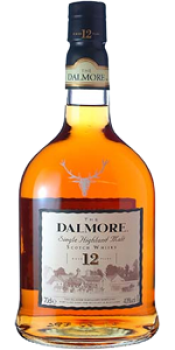
Single Malt Report: Dalmore 12 year old (old label, 2005 bottling)

This week, I declared that a Brora was better than a Craigellachie.  That's what is referred to in some circles as a steaming hot take.  With this post, I happily lay another steamer out just for you.

DALMORE!


Actually, this version of the 12 year old was bottled before the three-dimensional silver plastic stag head was glued to bottles, before the ABV was lowered, before the price doubled.  Yes, this was back when Dalmore 12 cost $25-$30.  And it looked like this:


Rather than going through a list of Dalmore gripes, I'll give you some background to this particular sample.

DistilleryDalmore
Ownership: Whyte & Mackay (United Breweries Group)
Age: minimum 12 years
Maturation: ex-sherry casks (likely American oak), possibly some ex-bourbons too?
Region: Highlands (Northern)
Alcohol by Volume: 43%
Bottled: 2005

Once upon a time, Florin (a prince) gave me one-third of his bottle of Dalmore 12 (bottled 2005).  We had tried the stuff the evening before he gifted the large sample, but I didn't remember what it was like.  He had found it to be noticeably peated.  Before I started into my 8oz, I sent 2oz of it to My Annoying Opinions in a sample swap.  Yes, you read that correctly: I swapped part of someone else's sample for a sample.  Yup.  Moving on...please see MAO's review here.  Though he did not find any peat in the whisky, MAO had some nice stuff to say about it.  There was further conversation about its peat levels in the post's comments.

Many months later, I finally tried the whisky and...... yyyyuck it was all rotten eggs with a hint of orange peels.  I let it sit in a half full bottle for a week before trying it again.  Things had changed.

NEAT
The color is rosy gold.  The first notes on the nose are hot hay and moss.  The rotten egg element while still present has mostly vanished.  LOTS of orange peel, though.  There are smaller prune, beach, and sweat (yes, with an 'a') notes.  Also some toffee and cherry lollipops.  The mild palate gradually grows sweeter with time.  The sherry stays subtle.  Some orange candies, raisins, salt, and moss.  A wormwoody bitterness and maybe some mold on the sherry casks.  The sherry ramps up in the finish, as does the sweetness.  Small notes of sea air, orange candies, and raisins.   Not much else.

WITH WATER (approx. 40%abv)
The farmy hay note remains in the nose, as does the orange peel.  More moss.  Buttery toffee and caramel.  Seaweed and canned peaches.  The palate gets bitterer, while the rest of the flavors flatten out into a blur, like a sherried blend.  Maybe also some burnt white bread crusts, stone fruits, toasted grains.  The finish has some sherry, tobacco, stale dried fruit, and grass.

It's definitely not boring, seeming to change with every sniff and sip, sometimes off-putting, sometimes fascinating, good and bad elements firing at the same time.  Thank goodness that rotten egg thing slipped to the background.

Next, I left the final ounce in a 2oz sample bottle for ten more days to see what a little more oxidation would do...


The nose is much fruitier now with raisins, prunes, pears, and green apples. No eggs! But also, no orange peel. Hint of moss, soil, and wet sand.  The palate remains mild.  The nice bitterness is still there.  More sherry.  A little pepper in the throat.  That pepper remains in the finish, along with the bitterness.  Some salt, sherry, and celery(!).

The more it oxidized, the better it got.  It basically went from an F to a C to a B-.  I don't really recommend adding water to it as the whisky is already light.  That rotten egg issue appears to be unique to my experience, so discount it (if you dare!).  While I would not say this is peaty whisky (probably a 2 on Serge's 0-9 P scale), there were mossy notes repeating in the nose and palate.

As MAO concludes, this was a reasonable whisky at $25.  Can't get much sherried malt (especially with an age statement) at that price.  Plus as I mentioned above, it gets points for amusement value.  I've seen a number of these older bottles on shelves in this neighborhood.  But at $50.  For half that price, I might bite.

Availability - Random corner liquor stores
Pricing - $25-$30 once upon a time, almost twice that price now
Rating - 80 (with oxidation)