...where distraction is the main attraction.

Wednesday, October 30, 2013

A Very Very Dusty Whiskey Monday Night: Ye Olde Americans

Focusing on the middle four bottles today.  See yesterday's post for more photos!
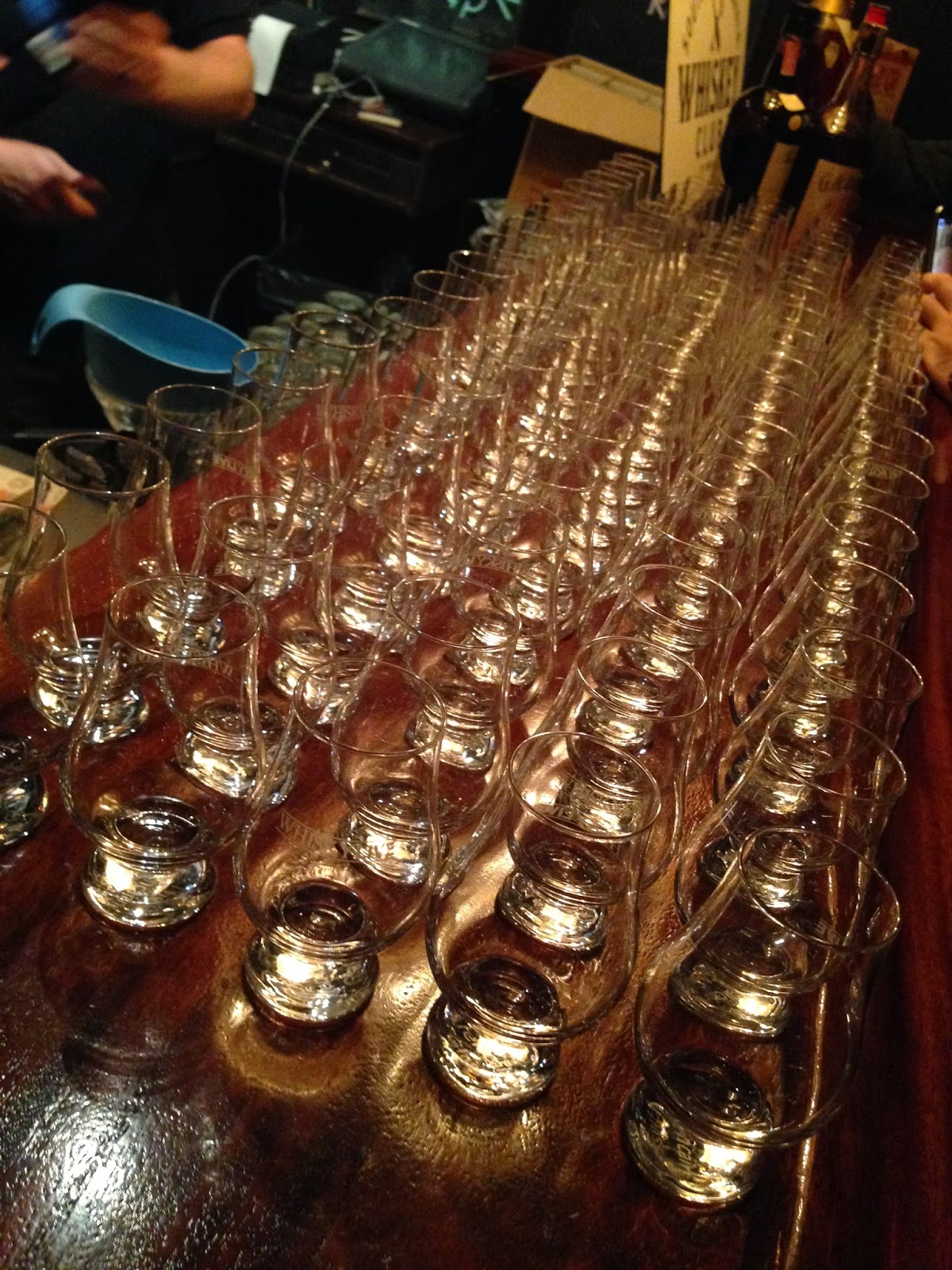
These six lovely old bottles greeted the tasters upon our entrance into Seven Grand's back room.  To make sure everyone was comfortable with the authenticity of the bottles, Chris waited to open them until the tasting began.  It's difficult to open very old dusties without breaking the cork, so Chris also brought along coffee filters to strain out any crumbles that dropped into the whiskey.  He actually only had to use them twice.  I think the guy has opened his share of old bottles.

Three of the four American whiskies were quart-sized, as opposed to 750mL.  They all had reasonable neck/shoulder fill levels.  For lower proof whiskies (80-86 proof), low neck fills are more of a concern than they are for higher proofs, as the creeping oxygen will make quicker work of the weaker ones.  Just something to keep in mind for those of us eyeing the markets for an oldie.  It is of my personal estimation that none of these were negatively oxidized.  But they were definitely old.

I kept two Glencairns going at once, switching back and forth between glasses, seeing if a little breathing time changed the whiskies.  Because a couple of the whiskies required cork filtering, we had the opportunity to take our time (and/or socialize) if we chose to.

The first one up:
Old Sunny Brook 4 year old Kentucky Straight Bourbon Whisky; bottled in 1941 -- thus distilled in 1937 or earlier; 93 proof.  One quart.  Fill level - 3/4 up the shoulder.

Old Sunny Brook distillery was likely built in the early 1880s but went by a number of different names during its first half century (Associated Distilleries of Kentucky, Old Kentucky Distilling Company, Old Times Distilling Company, Willow Creek Distillery, etc.).  The Rosenfield family bought it in 1892, then in 1914 it became Sunny Brook Distillery.  The Rosenfields sold the distillery in 1933 to American Medicinal Spirits (which itself was owned by National Distillers), just in time for post-prohibition distilling to start.  Though National Distillers closed the distillery in 1975, bourbon under the brand's name was still being bottled long after that, distilled elsewhere.  In fact Beam, who bought National twenty-five years ago, may still be producing a blended whiskey under the Old Sunny Brook brand name.

(Sources: http://www.pre-pro.com/midacore/view_distillery.php?did=DST357http://www.bourbonenthusiast.com/forum/viewtopic.php?f=17&t=1716)

What we had here was from the National Distillers era.


True to the back label's quip, the nose was indeed the most cheerful of all the whiskies sampled.  It started with hazelnuts, maple syrup, milk chocolate, dark cherries, walnuts, and vanilla beans.  With some air, notes of tree bark, chocolate eclairs, and peanut brittle emerged.  The palate was less expressive.  There were sugary candied notes, a little bit of the peanut brittle, some toffee, and a bit of alcohol bite.  Its finish was mild.  Toffee and ethyl burn.

I really enjoyed the nose.  Whether it's due to time, oxygen, storage, mashbill, or changes in production processes, the sniffer far exceeded that of any four year-old bourbon I've ever tried.  If oxidation did have any negative affect on the Sunny Brook, it would have been on the palate.  But perhaps that's how it tasted back in the day.

The second whiskey:
Old Hillsboro Reserve 5 year old Kentucky Straight Bourbon Whiskey; bottled in 1942 -- thus distilled in 1937 or earlier; 100 proof.  One quart.  Neck-fill low shoulder.

This was distilled by Bernheim Distillers Company (which was actually sold to Schenley Distilleries Inc in '37), but as you'll see in the picture below it is listed as Registered Distillery #1.  Bernheim Distillery was #9 in its region at this point.  But Warwick Distillery, formerly Old Times Distillery, was RD #1 in its region, and was bought by Bernheim in 1906.  Today, American distilleries use DSP (distilled spirits plant) numbers instead of RDs; Heaven Hill's Bernheim distillery is DSP #1.  I'm not sure how much that info helps, but on an interesting note take a look at the bottom of the front label.  This batch of Old Hillsboro was specifically bottled for an individual or family in North Hollywood, CA.  So we drank it close to home.

(Sources: http://www.pre-pro.com/midacore/view_distillery.php?did=DST298http://www.pre-pro.com/midacore/view_distillery.php?did=DST405http://www.bourbonenthusiast.com/forum/viewtopic.php?f=17&t=1660http://www.bourbondrinker.com/index.php?topic=1501.0)


The nose was strikingly similar to a contemporary mid-shelf wheated (or very low-rye) bourbon.  Caramel, vanilla, orange peel, and cinnamon were the main notes.  Only the hints of peanut butter and clay made it feel somewhat different.  The palate was bright yet light for a 50% ABV.  And it was chock full of corn and soft vanillin.  Its finish was very brief and oaky.

Though I don't have a lot of notes for the palate, I did enjoy it more than Old Sunny Brook's flavor.  Perhaps the softness was brought on by oxidation, as this bottle did have the lowest fill level.  But again, the smoothness may have been the style, as bourbon is usually made for drinking.

The third whiskey was a fun one:

G.R. Sharpe 4 year old Old Style Whiskey; bottled in 1917 -- thus bottled in 1913 or earlier; 100 proof.  One quart.  Neck-fill 3/4 up the shoulder.

Yeah, you're reading that right.  1913.  And it had one of the better fill levels on it too.

Chris did some research into this whiskey and found out its juice was from Elk Run Distillers (click here for a distillery photo from 1913).  My snooping turned up very little, other than the fact that Elk Run Distillers Co. was shortlived, 1906-1919.  You'll notice no mention of "Bourbon" on the bottle.  This may have been blended whiskey or bourbon.  Chris mentioned that as the reality of impending national prohibition was gaining steam, and as individual states went dry, many companies rushed to bottle as much whiskey as possible as long as it was legal to do so.  This very bottle may have been one of the results.

(Source: http://www.pre-pro.com/midacore/view_vendor.php?vid=SDF18525)


Mothballs!  Mothballs on the nose.  Furniture stain, old lady perfume, definitely grandma's closet.  Some chlorine in there.  Maybe some slightly stinky cheese.  But with some air (like 20-30 minutes worth), a big rich caramel candy note bursts forth.  And also mothballs.  Mothballs again on the palate, followed by a lighter floral perfume than was on the nose.  A smidgen of caramel.  The finish held the light perfume and caramel.  A little bit of palatable bitterness.  No mothballs.

This one caused all sorts of negative exclamations, hyperbole, and outcries from much of the crowd.  All of which seemed very goofy to me.  I'm not sure why everyone was being so sensitive.  This is whiskey, damn it, and ancient stuff at that.  I enjoyed this one.  I even snuck a second pour.  This was different from the rest.  It felt old.  I'm thankful for the opportunity to have tried an American spirit distilled 100 years ago.

The fourth whiskey, and last of the Americans:

Old Forester Bourbon Bottled-in-Bond; distilled Spring 1952, bottled Fall 1957; 100 proof.  4/5 Quart.  High neck fill level.

Ah yes, the lava rocket sex toy.  The Fifties of The Future!


Before 1890, Brown-Forman was JTS Brown & Brother.  Their first brand, back in 1870, was Old Forester.  It's been theirs ever since.  Right around 1959, they lowered the proof of OF to 86 for a little while, so this was one of the last of the 100 proofs for a while.

(Source: http://www.bourbonenthusiast.com/forum/viewtopic.php?f=17&t=1758)

The nose was full of maple syrup and black pepper.  Lots of warm baking spices too -- possibly from the rye content -- like cinnamon, nutmeg, and cloves.  Also some walnut cookies and raisins in the mix.  There was more corn than rye on the palate.  A mild easy drinker, another one that seems contemporary.  The finish became much more fragrant and warm with the baking goodies returning.

When I reference the "contemporary" thing, I mean that I'd bet most folks would never know that this was distilled over sixty years ago if they weren't told so.  I count myself among those folks.  To me it would fit in with Old Forester's current range, though maybe a little better.  :)


As you'll note, I'm not dishing out ratings for any of these four.  The atmosphere was not suited for grading, it was suited for the group experience.  Of these four noses, I enjoyed the Old Sunny Brook best.  The palates were mostly even.  But overall, the G.R. Sharpe is the unforgettable one.

Next up, the two Scotch blends...

Tuesday, October 29, 2013

A Very Very Dusty Whisky Monday Night with the SCWC

Last night, I attended Southern California Whiskey Club's pre-1964 Whisk(e)y Tasting at Seven Grand.  I took a lot of photos because, seriously, when is this ever going to happen again?

I sort of have my hands full today, so I'll let the pics do most of the talking.

Chris, the host with the most.
Michael R., also the host with the most. Also loving life.
So much potential...
The full lineup, a little blurry. Let's look closer.
#1. Old Sunny Brook 4 year old Bourbon 93 proof
Distilled 1937 - Bottled in 1941
#2. Old Hillsboro Brand Bourbon 100 proof
Distilled 1937 - Bottled in 1942
#3. G.R. Sharpe Old Style Whiskey 100 proof
Distilled 1913 - Bottled in 1917
#4. Old Forester Bourbon 100 proof
Distilled 1952 - Bottled in 1957
#5. Ballantine's 30 year old Blended Scotch Whisky 86 proof
Distilled in the late 1920s to early 1930s
Bottled between 1954 - 1964
#6. Ambassador 25 year old Blended Scotch Whisky 86 proof
Distilled in the 1920s
Bottled late 1940s to early 1950s

Later this week, I'll talk about each of these six.  In the meantime, I will leave you to ponder the Old Forester bottle.  Could it double as a lava lamp?  A sex toy?  Or a rocket?

Or a lava rocket sex toy?
(Also known as whiskey.)

Friday, October 25, 2013

This week in French whores and whisky

(source)
First of all, if your French whore smells of perfume, violets, and soap, you should count yourself lucky.  Just imagine the myriad of intimate odors she could otherwise smell of.  I understand that FWP is shorthand for characteristics peculiar to a specific era of Bowmore single malt, but if one was to use "French Whore Perfume" as a metaphor then it would work much better with the multitude of stunt finishes currently being heaped upon Scotch whisky.  Murray McDavid comes to mind first.  With their ACEing finishing of almost all of their releases in Chateau Lefart casks and Skittles firkins, MMcD often seems to be trying to hide a warehouse full of questionable whisky with French showers.

Apologies to the French for all of this.

Secondly, I spent way too much time trying to write Tuesday's post.  I wrote then cut four additional paragraphs defending the idea of "bad" whisky then realized I was either going in circles or expending too much energy not talking about the whisky itself.  When it comes to writing about imposing one's personal conceptual structure onto objects being observed, sometimes one can and sometimes one Kant.

......

......

*crickets f---ing*

......

Wow, tough crowd.

We all have our own opinions about what is palatable and gross in whisky.  There seems to be a mixed tolerance for floral notes.  I like the ones that smell like actual blossoms, I don't like the ones that smell like bathroom spray.  Some folks feel the same, others don't.  Soap notes are particularly difficult.  Dish soap is not pleasing to the human palate for the most part.  (If, for some reason, you doubt me on that, go ahead and give your kitchen dish soap a few licks.  Then some hand soap and maybe some shampoo.  Then allow yourself a slug of the 1984 D&M Bowmore I referenced on Tuesday.  You'll find they're all equally pleasing.)  But a hint of soap doesn't negate a whisky, according to my palate.  On that 0-9 soap scale -- with "9" being the old liquid Dove soap I used to use when washing my parents' cars -- I still enjoy whisky that registers a 2, can forgive a 3, and will finish a glass of 4.  But some folks hate the very hint of soap in the mouth.  That's fine.  In fact, that's probably very good, as their brain's defense mechanisms are working better than mine.

Even so, I don't think that all FWP-era Bowmore should be written off as the same.  There's so much potential for variation in whisky -- individual batches, distillery management, vintages, ages, bottlers, casks, warehouse placement, bottle storage -- that there are some good ones amongst the bad ones.  Sadly (or not so sadly in some folks' opinion) that era of Bowmore's whisky brings a sizable purchase price.  I never recommend anyone to buy something blindly, so before you splurge on a potentially weird bottle make sure you do your research online.  The bottlings from '90-'91 often bring positive reviews; and there are some '80s Rattray, G&M, Macarthur, and Duncan Taylor that Serge likes.

I won't say it's not a gamble, every blind purchase is a gamble, but be educated about your choices.  And don't accept every bit of popular whisky shorthand as your own personal truth until you've tested it yourself.  Who knows, maybe you'll find a perfume-free bottle.  Or maybe you're just the saucy type who likes a little FWP.

Thursday, October 24, 2013

Single Malt Report: Bowmore 20 year old 1991 AD Rattray (Cask 2061)

On Tuesday, I wrote about FWP-era Bowmore and took a brief look at two single malts from that period.  On Wednesday, I explored a third malt a little deeper.  Today, I'll present a fourth malt.  This time it's from the nebulous borderlands of FWP and the so-called improved era that followed.

This whisky was distilled when the Morrison family still held majority ownership of the Bowmore distillery.  After Suntory bought them out, the Morrisons formed the independent bottling company, A.D. Rattray.  Thanks to their connection with the distillery they've been able to secure some casks in the years since.  The A.D. Rattray Bowmores tend to have a good reputation, so I wouldn't doubt the Morrisons knew which were the good casks to pull.

This sample came from a whisky swap I did with Florin almost a year ago.  I was waiting for a good opportunity to spring it, and here it was.

Distillery: Bowmore
Ownership: Suntory (Morrison Bowmore Distillers Ltd. at time of distillation)
Bottler: A.D. Rattray
Age: 20 years (15 July 1991 to 15 September 2011)
Maturation: Sherry cask
Cask: #2061
Region: Islay
Alcohol by Volume: 56.2%

NEAT
The color is reddish mahogany.  After a 25 minute rest, the whisky's nose is full of ripe dark berries and a berry syrup.  There are pencils, golden raisins, and something in the molasses-rum arena.  There's also a peated sherried lavender note that remains in the mid-ground throughout.  There's also a little bit of coastal Islay in there, a salty seaside and band-aid-like phenols.  And far in the distance is a manured lawn.  After about 50 minutes, notes of cologne and menthol arise.  The palate leads with black pepper, burnt seaweed, and barbecued dog hair (sorry, no link Ghostbusters video).  And someone rolled up that lavender and smoked it.  There's some raw horseradish, sweet sherry, and just a whisper of soap.  A lot of char in the finish, like charred sherry if that was a thing.  That soap hint vanishes, leaving ashes of all kinds (wood, paper, peat moss) to linger long.  It's immense.  Sweet sherry and a spliff.

WITH WATER
On the nose there's a nice merging of sherry and sweet peat, reminiscent of Uigeadail.  GOOD note of struck matches.  Mint and menthol compliment a bright floral note.  A big brick of peat moss floating in brown sugar syrup.  More char and sherry in the palate.  There's a little (pleasant) bitterness.  The lavender and soap characteristics seem to grow again with added water.  Lots of sherry in the finish.  Flower blossoms (something between lavender and violets). Mild peat char.

This is my favorite of the four.  It's the biggest boldest sherriest Bowmore I've had so far.  The smoke is marbled nicely throughout the palate and finish.  The nose is great again, though very different from yesterday's Bowmore.  Comparatively, there's more Islay aggression here with different fruits and fewer candies.

Now, about that light soap note......Is 1991 still within the FWP-era?  It's a close one.  Originally, I thought that FWP continued into the early '90s, right up until ownership changes in 1993.  Though Serge Valentin shouldn't have the only word on whiskies (remember, we all have our own sensory realities), his site does have the most extensive and detailed (and un-paid) whisky reviews online and I concur with his notes more often than not.  For instance, he has 318 Bowmore reviews at the moment.  Around 115 of those reviews are for 1980-1992 distillations.  Almost all of the '89s have references to perfume and/or soap.  Only 5%-10% of the '90/'91s have such references.  None of the '92s have them.  So, to Serge's refined nostrils and palate, nearly all of the 1990 and 1991 Bowmores were free of the FWP notes.

Did my pre-existing assumptions of FWP dates influence my experience of the soap note?  I don't think so.  I'm not 100% certain, but maybe 99%.  I'll leave that 1% to psychological factors.  The good news is that on a soap scale of 0-9, the note was 2 on the palate and 0 on the finish, while served neatly.

Again, I recommend leaving water out of this one.  Though the whisky is intense when neat, adding water doesn't seem to improve the experience.

Tomorrow I'll do a brief recap -- with fewer words! -- to conclude this FWP voyage.

Availability - This cask is mostly sold out, but can still be found with some snooping
Pricing - was $110-$120, probably a little higher now
Rating - 88

Wednesday, October 23, 2013

Single Malt Report: Bowmore 21 year old 1982 Prime Malt

Yesterday, I asked the question "Is all FWP-era Bowmore whisky bad?".  Then, amongst a bunch of other words, I gave a brief explanation of FWP (French Whore Perfume, a descriptor of a set of characteristics unique to a difficult era of Bowmore malt), some background on the term, and a defense of the possibility of "bad" whisky.

While I agree there seem to be considerable artificial floral and soap notes in the early eighties to (possibly) very early nineties Bowmore single malts, I think that sometimes those notes exist separately from one another.  Sometimes there's a fake perfumy character without it getting soapy and sometimes there's a lot of soap without the fake flowers.  Sometimes there's both.  And sometimes I've found strong whiffs of actual lavender blossoms.  While these notes may be present, they're not always consistent.  Not all FWP Bowmore smells and tastes the same -- there were hundreds of thousands of casks, dozens of bottlers, dozens of age/vintage permutations, and well over a million bottles.  And (to me) a few flower blossoms in the whisky isn't necessarily the worst thing in the world.  But too much soap, can render an otherwise decent whisky unpleasant.

Yesterday, I briefly reviewed two FWP-era Bowmores that I sampled at a tasting in April.  The first, an independently bottled 1984 was pretty awful.  Though unique, its dish soap, bug repellant, and deodorant notes were tough to swallow.  The second whisky, an official cask strength 1989, was less hideous.  Its nose was pleasant, the palate challenging, the finish odd.  Its bad third act did it no favors.  While there was little to no artificial perfumy notes, there still was some bitter soap in the mix.

Today's whisky is a 1982 Bowmore bottled by an indie label (Prime Malt) that may have been owned by Duncan Taylor.  I use the term "may have been owned" because though the label references Duncan Taylor, a DT rep suggested to me that rather than owning the brand outright Duncan Taylor may have assisted a third-party cask owner in bottling and distributing its whisky for the market.  Prime Malt's last appearance seems to have been about ten years ago, but a few of their (non-Bowmore) single malts may still be found.  I have a pair of other Prime Malt whiskies to review in the future, but I can tell you now that those two lean, almost oak-free, malts appealed to me.

My Prime Malt experience would not exist without the generosity of Florin who shared some good whisky with me on my birthday this year.  This sample of '82 Bowmore is also from his bottle, right from the top of it in fact.  Thank you, Florin!


Distillery: Bowmore
Ownership: Suntory (Morrison Bowmore Distillers Ltd. at time of distillation)
Brand: Prime Malt (this is the fourth of their "Finest" selections)
Bottler: Duncan Taylor
Age: minimum 21 years (distilled in 1982)
Maturation: likely refill ex-bourbon casks
Region: Islay
Alcohol by Volume: 46%
Chill filtered? No
Caramel Coloring? No

NEAT
The color is a medium amber with some gold around the edges.  After a 20 minute rest, the whisky's nose expresses itself immediately as cotton candy at the beach.  Seaweed, peat smoke, and iodine dance well with caramel candies, overripe mango, and (yes) lavender blooms.  Maybe even some violets.  After 45 minutes, a wave of fresh pears, oranges, and white peaches washes over it.  Maybe a little sweet cream too.  The palate shifts directions.  The lavender is still there, along with a subtle sweetness.  But then cigarette smoke, dog fur, and generic dish soap enter the picture. Very little oak here -- a touch of vanilla -- so a big barley note peeks through.  Finishing up, the whisky gets more challenging.  More soap here, and the separate lavender note grows larger.  It's also lightly sugary with a mild lemon rind note in the background.

WITH WATER (just a few drops)
The fruits (mostly pears) take front stage in the nose.  Some sweetened grapefruit juice as well.  While there's more vanilla and less lavender, the whole thing feels......feminine.  Hydration does the palate no favors.  The dreaded elements come together.  Lavender + soap = lavender soap.  The peat goes lightly sweet and mossy, but there's something bitter developing.  It finishes with dish soap and Dove soap. Much drier.  Lots of citrus.  Meanwhile the lavender grows progressively more artificial.

Since those last few sentences won't inspire anyone, I'm going to accentuate the positive first.

I'd go as far to say that if I had a Top 20 all-time favorite whisky noses, this would be in the running for the list.  It smells gorgeous, not despite the odd notes, but because of them.  It conjures up the seaside, fruits, sugary candy, and spring blossoms all at the same time.  While not as stunning, the palate does not cave into the soap note and remains very drinkable.

But.  Do not add water.  Just a few drops turns the whole palate experience super sudsy; as in, it'll lead you to try to blow soap bubbles off your tongue.  That is probably not a good thing.

Is this "bad" whisky?  In my sensory reality, no.  In fact the nose is "excellent".  It's a difficult one to recommend to folks, as there are so many qualifiers.  You have to be okay with the lavender notes.  And you can take a little soap in your face.  And you can't add water.  And you have to be able to actually find a bottle of this stuff.

Availability - Not
Pricing - ???
Rating - 81 (though the nose is an easy 90)

Tuesday, October 22, 2013

Is all FWP-era Bowmore whisky bad?

I was trying to figure out how to start this three-part Bowmore mini-series yesterday morning when I came upon David Driscoll's recent What Do You Make Time For? post.  In it, he writes this:
...I'm not even sure there is such a thing as bad and good, but rather simply what one likes and what one doesn't like...
Well, since the question tilts philosophic, let's get philosophical.  Since David's sentence frames "good" and "bad" as words we assign to experiences using personal criterion, then we're dealing with judgment being applied to the subjective.  Since consciousness is experienced through the prism of our personal perception which is constantly being shaped via our sensory experiences which determine the aforementioned criterion, might reality be subjective?  And if, in a subjective reality, one consumes something that is made to be consumed yet it makes one want to stop consuming it, can that "something" not be judged a failure within one's reality?  I'll get back to this in a sec, hopefully using fewer words.

How about the objective experience?  The brain utilizes our five senses for protection.  Our ears hear the screech of fire clarions and bombing sirens.  Our eyes see Godzilla approaching (you seem him too, right?).  At the same time, our nose and mouth can pick out qualities that trigger a defensive response against poison or sickness.  On the other side of things, those same senses are utilized to take in experiences that release our pleasure hormones.  Because we are not identical creatures, different things release those happy hormones.

Whisky is a liquid made to be consumed by consenting humans.  It's also mostly poison......but we drink it for pleasure.  If a whisky contains scents and flavors that provide instantaneous pleasure, is it not successful?  If a whisky contains scents and flavors that cause us to gag, wince, fear our drinking choice, or immediately produce negative feelings, isn't it a failure?  Yes, it is a personal experience.  But it is something we register on a vast negative-to-positive spectrum, often resulting in either a second glass or a spill down the sink.  Again, success and failure.  Good and bad.  Since each of us lives in his or her own realities, there is thus A LOT of good and bad whisky out there.

Okay, let's try a different objective approach.  Let's say there's a distillery in Scotland (just imagine that for a second).  After changes are made in the mash, yeast, washtubs, and/or distillation processes, the character of that distillery's malt whisky changes.  The very scents and flavors created by this process change lowers the distillery's entire reputation from being one of the best in the business to one of the worst.  The whisky alone does this, not bad marketing nor poor packaging nor corporate social ills.  The whisky annihilates brand's reputation on its own.  Would that not be bad whisky?

(source)
The good gents of PLOWED coined the term "FWP" (or "French Whore Perfume") for specific characteristics found in a stretch of what many connoisseurs consider to be terrible quality Bowmore single malt, distilled somewhere between the early eighties and the early nineties.  Many whisky fans who have had the pleasure (either by being born at the right time or compiling enough income) to drink Bowmore from the fifties through the seventies, proclaim its magnificence.  Imagine the disconcerting experience when changes made to Bowmore's processes led to an abrupt shift in the whisky's characteristics.  Gone were gorgeous tropical fruits, in their place came waves of flowery soap and inexpensive manufactured fragrance.  As you can imagine, there was some concern.

The actual FWP dates are fuzzy.  They seem to have started with whisky distilled near 1982 and ended at some point during the early nineties.  Part of the issue regarding the uncertain conclusion of this period is the fact that the lavender note found in FWP-era whisky can sometimes still be found, though more faintly, in the Bowmore malts distilled in the decade following.


Here are a bunch of fun links regarding FWP Bowmore:
--http://www.whiskymag.com/forum/viewtopic.php?t=2443
--http://www.whiskywhiskywhisky.com/forum/viewtopic.php?p=41556 - These first two links are online forum discussions about FWP.
--http://www.myannoyingopinions.com/2013/04/18/bowmore-from-the-edge-of-the-danger-zone/ - Here's a link to M.A.O. doing some further questioning of FWP.
--http://whiskyscience.blogspot.com/2011/06/lavender-in-whisky-conspiracy-of-french.html - Whisky Science explores the possible scientific reasons behind the lavender notes.
--http://www.guidscotchdrink.com/2010/02/say-what_2894.html - Jason Johnstone-Yellin interviews --Serge Valentin on his thoughts about FWP Bowmore.
--(There's also a great Malt Maniac e-pistle from David Broom about this, but the link is dead.  Please let me know if there's an updated link and I'll add it here.)


Do I think FWP is an actual thing?  While the power of suggestion (courtesy of reading articles like these) can greatly influence a person's whisky experience, it's tough to disagree that there's something curious going on in the FWP-era Bowmores.  Also, people with much much MUCH more whisky experience than I embrace the FWP designation and find that period to be Bowmore's worst.  So, I'm game so far...

But is it all "bad"?  Or is it "consistent"?  The latter term is observational, the former judgemental.  I tend to think whisky is rarely consistent, which is part of what makes it fun.  Even within a single bottle, the whisky at the top often tastes different than the stuff at the bottom due to oxidation.  Bottles within one release can differ due to the numerous casks in the mix.  And I'm beginning to consider that storage conditions will affect a bottle's nose and palate.  Thus there's bound to be many differences between vintages, casks, warehouses, ages, and bottlers of the FWP-era Bowmore.

As far as the FWP characteristics go, I'm not grossed out by lavender, violets, or geranium notes.  But soap notes are a concern.  There's a reason your Mom washed your mouth out with soap after you called the lunch lady a ----.  And there's a reason why we don't leave a nice coating of soap on the dishes after a wash.  I'm not crazy about soap notes.  And while they're not a deal breaker, they don't leave good sense memories behind.

My experience with FWP-era Bowmores has been limited compared to folks like Jim Murray and Serge Valentin.  (Serge has tons of Bowmore reviews here.  While I do enjoy the schadenfreude in reviews like these, Serge does find some of the 80s Bowmores to be very good.)  This year I took notes on four very different Bowmores distilled during the suspect period.  Two of them will get their posts later this week.  Two of them I'm listing below:

These two whiskies were sampled at a much larger tasting hosted by the SCWC earlier this year.  Because the atmosphere was casual and not suited for a full report, the notes are limited and official ratings not included.

Bowmore 28 years old March 1984, D&M Aficionados Club (Lorne Mackillop's Cask) - Cask No. 59068 - 50% ABV

Color - Very light amber
Nose - Three very obvious notes: 1.) The mothball, menthol, eucalyptus realm. 2.) OFF bug repellant roll-on stick, also from the '80s. 3.) Cheap deodorant.
Palate - Very little oak and mild peat.  Mostly acrid perfumed soap.
Finish - Boatloads of the perfumy soap, and maybe some generic dish soap too.

There was at least two "Oh, that is disgusting" remarks by other folks at the tasting.  Normally, I would offer to relieve someone of a problem whisky, but frankly I had enough of this one after a half ounce. Interestingly, there wasn't much of a floral character to this one. The "perfumy" part was very artificial and chemically rather than musty or floral.  But the actual soap note was unmistakable.  This was a very educational dram.

Bowmore 16 years old 1989/2005, Official Bottling
Bourbon casks - 51.8% ABV

Color - Light amber
Nose - Lots of buttery creamy American oak looms in the forefront. Very light peat, barely a wisp of smoke too. After a few minutes, some lawn manure.
Palate - Lots of charred American oak gives it a surprisingly bourbon-ish character at first.  Then after a couple minutes, some wood embers.  Then some mild Dove soap.  Then things get bitter.  Time is not on its side.
Finish - Not much at first, sort of a palate echo.  Then comes the bitterness and soap.

This one pulled the switcheroo on me.  I liked the nose quite a bit.  The palate was quirky, going from okay (oaky) to weird.  The finish went from quiet to unpleasant.  But it was a full step up from the '84.  But again, very little to no lavender...

So, were these "good" or "bad"?  I never want to drink the '84 again.  To my nose and palate, and my sensory reality, it was not a successful whisky.  Thus "bad", but consistent!  The '89, while fun to nose, ain't that enjoyable for drinking.  I would not recommend it to anyone outside of the more adventurous types.  So it falls more on the negative side of the spectrum.

Stay tuned for two entirely different FWP-era Bowmores, as I'm able to dig a little deeper into the whisky with a Taste Off at home.

Thursday, October 17, 2013

Single Malt Report: Balblair 1997 (first US release)

How about a single malt report without a bunch of other ramblings and rants tied in?  I miss posting those.  I actually had a Taste Off scheduled, but my nose and palate seemed to have taken a vacation from me this week.  It's a good thing I have this single tasting in my notes from two weeks ago.


Balblair is one of the easiest single malts to spot on the shelf.  Like Glenrothes, it has a squat rounded bottle, shorter than the rest of the whiskies on the shelf but wider.  The bottle is secured inside an even wider cubic box, usually displaying a single primary color.  As a result it takes up more shelf space than any other non-luxury whisky.  That's an interesting approach from a sales/marketing perspective, but probably a little irksome for retailers.


The 1978 "vintage", my primary birthday malt for the last two years, has proven to be a lot of fun, getting fruitier and fruitier the further down the bottle I've reached.  But until now, it was the only Balblair I'd had.  That seems a little backwards for a cheap-malt-cheering grump like me.  Thankfully my buddy JLR hooked me up with sample of the 1997 during a swap last year.

The 1997 "vintage" used to be the youngest of the range, but over the last couple of years the distillery released a 2000, 2001, and 2002.  While they don't state the bottling year or age on the bottle (though it can usually be sussed out via the bottling code), I do know that this 1997 was from the first US release in 2009.  Last year they released a 15-year-old version overseas, though I don't know if they've done the same in the US.

After four years, this first version of the 1997 has become difficult to find on the shelves, but I've spotted them at random corner liquor stores at decent prices, so my curiosity has been on the rise...

Distillery: Balblair
Ownership: Inver House Distillers Limited
Age: approx. 12 years (1997-2009)
Maturation: first fill ex-bourbon casks
Region: Northern Highlands
Alcohol by Volume: 43%

From a 30mL sample, courtesy of JLR, tried neatly only:

The color is a very light amber, which makes me wonder if the caramel colorant is either absent or kept to a minimum.  The nose is very shy at first but rather pretty.  And with time it comes out of its shell.  There are lemons, caramel sauce, pears, nectarines, and vanilla ice cream.  There's also a floral note which reads more like actual flowers than perfume.  With more time the vanilla ramps up and a bubblegum note emerges.  The vanilla is present up front in the palate.  A bunch of white fruits as well, like pears, apples, and white grape juice.  Again the floral (as in flowers) note, along with some whipped cream and malt, all lightly sweet.  It gets creamier and vanilla-er with time.  And it grows more spirity, rather than calming down with time in the glass.  The finish gains some new characteristics like black peppercorns, dark chocolate, and unsmoked cigars.  It remains sweet and malty with a little bit of peach liqueur in the background.

While I'm not adding much to the mostly-positive reviews given by My Annoying Opinions and Chemistry of the Cocktail, I have to say I wish I'd tried this back when they had.  Its character fits exactly what I was searching for when the heat hit Southern California.  While it may be delicate in character, it is not characterless.  It feels like it's in the style of the "Lowland Ladies", yet makes for more interesting drinking than most of the Lowlanders I've tried.  It won't blow your mind, but it's cheerful enough that it'll lead you back for a second glass.  Now, I gotta go get me that second glass.

Availability - Some major liquor retailers, though it's getting scarcer
Pricing - $48-$56
Rating - 85